
TV Review – Lord Of The Flies; How To Get To Heaven From Belfast
Jack Thorne’s Adolescence raised questions about the violence inherent in young males, but William Golding’s novel Lord Of The Flies was there years before him. It was always inevitable that Golding’s famous story of boys stranded on an island and turning feral would be remade again for television; and after the success of Adolescence, Thorne was a sensible choice to adapt it. The results, though, are less than the sum of the parts.
It begins, without much explanation (as did the novel), with a boy we will later know as Piggy (played by Belfast actor David McKenna) coming to and retrieving his glasses from among some weirdly green tropical plants. We follow Piggy (an officious child, but uneasy with the irrational ways of people and social hierarchies) as he explores the lush island he’s been washed up on, meeting up with other survivors. It turns out they’re all boys – no adults having survived whatever went wrong – and as they try to organise into some kind of functional society, they begin a fractious descent into darkness.
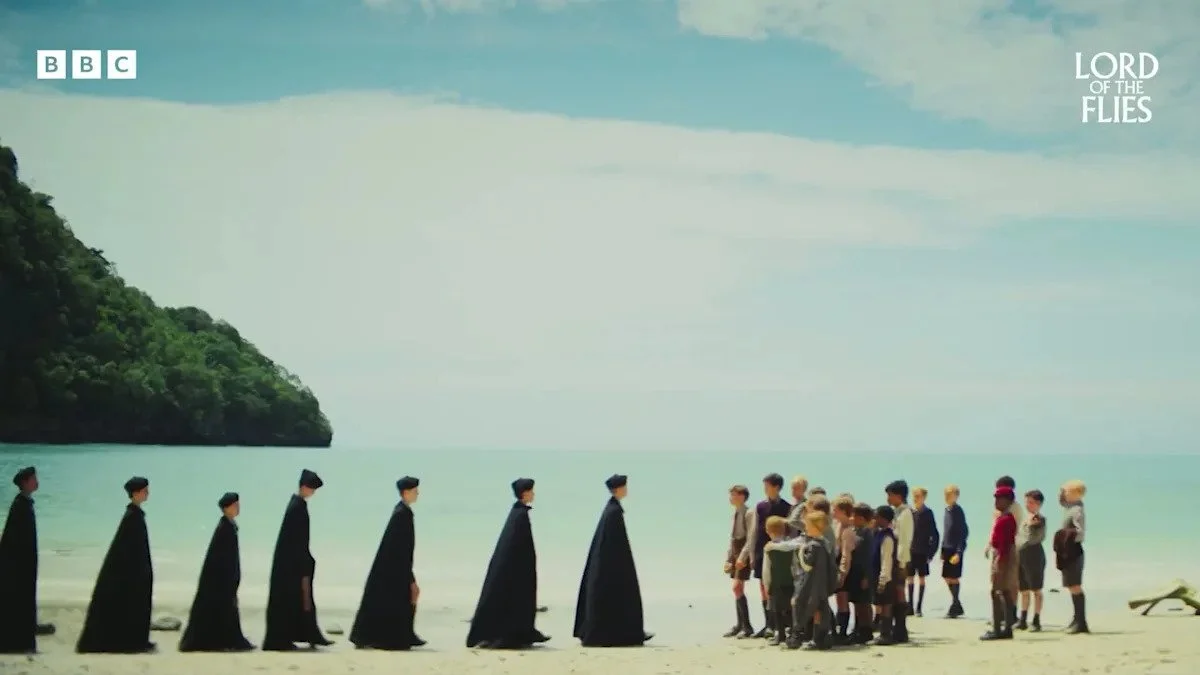
Hints of the Nuremberg Trials on the beach in BBC’s Lord Of The Flies
The series’ casting is quite good, chiefly McKenna as the prim but vulnerable Piggy, and Lox Pratt giving Malfoy vibes as Piggy’s privileged arch-nemesis Jack. There are some set pieces (the choirboys arriving at the beach) that, while not entirely believable, are visually striking, and if you know the book you know it’s not all fun and games (despite a blaring soundtrack that is probably supposed to be unsettling but nudges the tone towards boys’ own afternoon telly).
But there are so many problems that it never convinces, never generates the dread it needs. The colour is always too saturated, and the script often too weak, for it to feel real (“The sky is darkening, the beast approaches” sneers the 12-year-old Jack). Right from the opening, there’s a strange lack of trauma or curiosity about whatever disaster has just left them stranded, although on the other hand the camera is often too curious about the many real and CGI creatures found on the island: can we just get with the story, please? (While we’re at it, those repeated close-ups of the younger children staring into the camera don’t help with anything either.)
And on a tiny, just-pointing-it-out note, it’s hard to imagine why Piggy would answer the question “what should I call you?” not by saying his name, or any other name, or any other word, or even any of the random noises a voice can make, but by offering the one thing in the world he does not want to be known by – Piggy. Come on now.
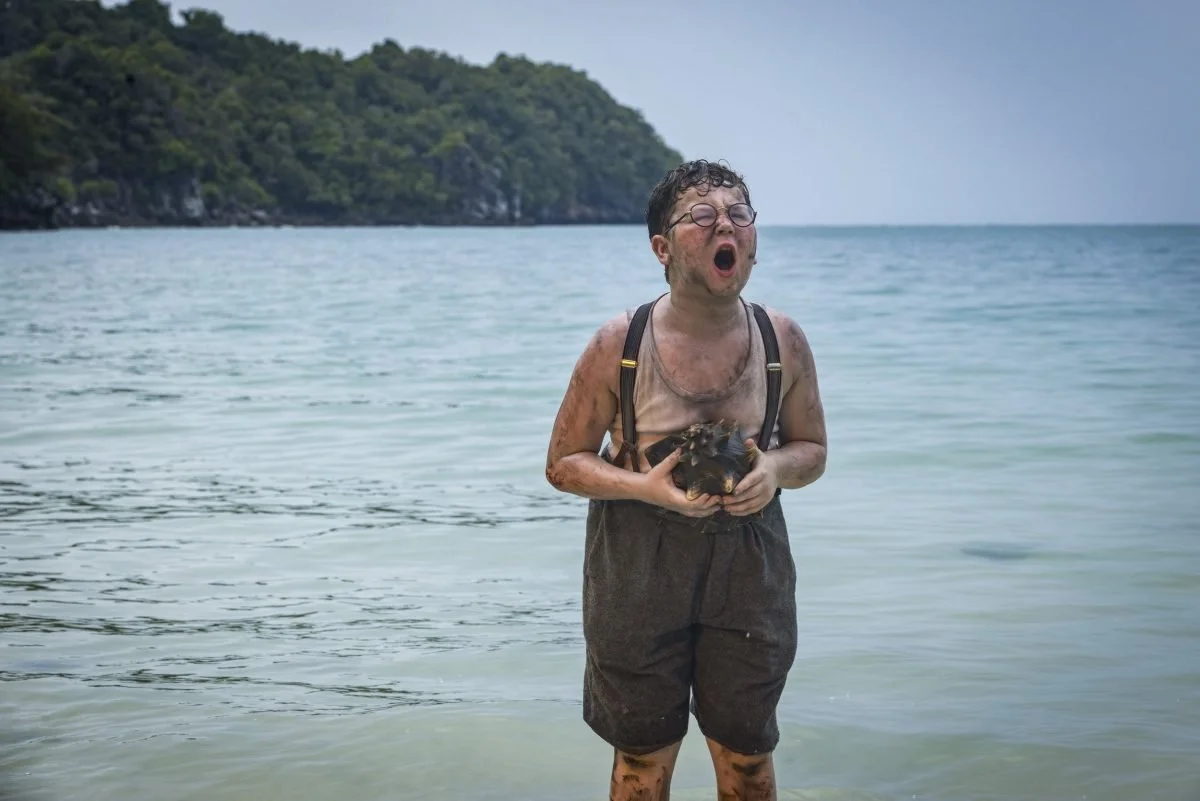
David McKenna as Piggy
Netflix’s new series How To Get To Heaven From Belfast also has problems with simply feeling real enough. This is Lisa McGee’s new series, her follow-up to Derry Girls, and in its mix of comedy, mystery, and road trip, it promises a twisty viewing experience unlike almost anything we’ve seen before. It begins with a flashback of a burning house, introducing us to four teenage friends who have grown up and slightly lost touch. There’s Saoirse (Roisin Gallagher), a TV writer, Dara (Caoilfhionn Dunne) who works with computers, and Robyn (Sinead Keenan) a hyper and stressed mother of four; and there’s Greta (Natasha O’Keeffe), who has been living in Donegal and whose death is the impetus for the other three to get together again to go to her wake.
Of course, at that uncomfortable wake, Saoirse discovers something about the body in the coffin that tells her something very sinister is afoot – so beginning a madcap chase that, in episode one took us around a handsome Dunlewey, but will end up who knows where? And will we get to the bottom of whatever happened with that burning house all those years before?
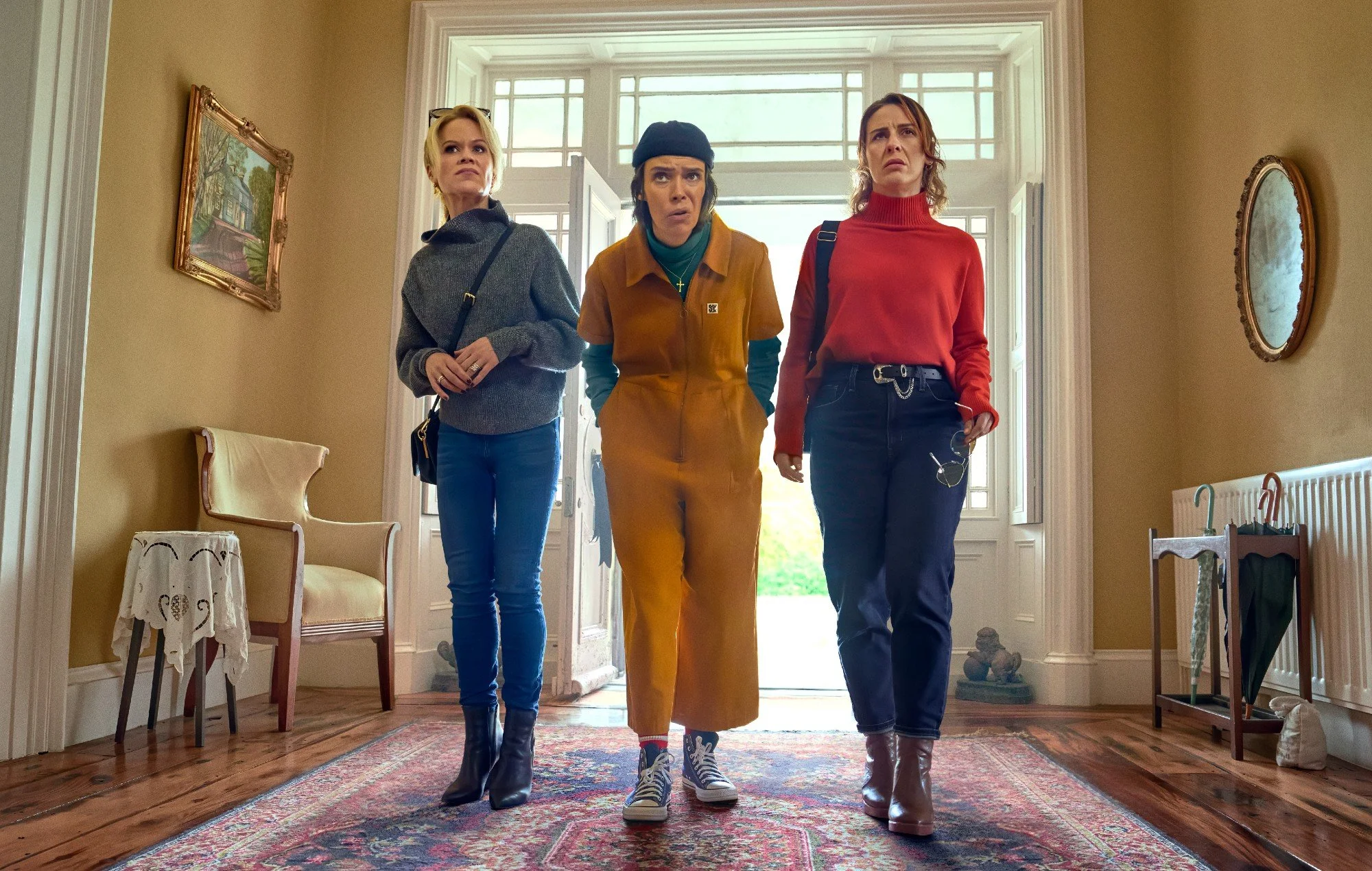
Arriving at the oddest of Donegal wakes in How To Get To Heaven From Belfast
There is, perhaps, too much Derry Girls DNA here: the gang of female friends, the exaggerated expressions and delivery, the sweary Ulster dialogue. Maybe it’s at this point that I should suggest meekly that Derry Girls, as likeable as it often was, was really a number of inspired individual scenes (that blackboard) scattered among three whole seasons of gurning faces that weren’t always that funny. Well, that same cartoonish gabbiness is here too, right down to a tiresome machine-gun monologue from Dara that almost kills the whole show within ten minutes. Trying to blend that kind of humour, and those kinds of larger-than-life characters, into something that also tries to be a thriller and a regretful look at the passing of time is almost impossible, like Bugs Bunny hosting a documentary about the Black Death.
That said, there are some things that do work: Donegal looks great, there’s a dancing scene in episode one (in which the central three dance with their younger selves) which is surprisingly affecting, and it even manages to get Emmett J Scanlan (as Greta’s husband) to speak audibly. And if most of the comedy is a bit shrill, Ardal O’Hanlon (one of many familiar faces popping up) gives a nicely-judged performance as a local hotelier that means it’s not completely without laughs. So there might be enough to keep you watching for a while, but while you admire the intent to be unpredictable, it’s mostly a busy mishmash of clashing tones.
