
The Origins Of Ash Wednesday
It didn’t become part of the calendar until around the 10th century, but the origins are pre-Christian
The origins of Ash Wednesday are a blend of ancient Jewish tradition, early Christian discipline, and their later medieval formalisation. It’s often said that, like many Christian rituals, it comes from pagan roots, but that’s not quite true: it does come from non-Christian roots, but it’s more a case of religious evolution into something still marked across the western Christian world (it’s marked, at least to some degree, in "High Church" traditions that follow a structured yearly calendar, like Catholicism, Anglicanism, Lutheranism, and Methodism).
Before Christianity ever existed, the use of ashes was a well-established Middle Eastern sign of grief and repentance. In the Old Testament, figures like Job and Daniel put on sackcloth and ashes to show humility before God. Symbolically ashes represented mortality (dust to dust) and the general worthlessness of the self in the face of God. Early Christians, who were initially largely Jewish, naturally carried this familiar cultural vocabulary into their own spiritual lives.
Still, in the first few centuries of the Church, Ash Wednesday didn't exist as a calendar event. Instead, ashes were used for public penance. If a Christian committed a grave sin, they had to undergo a period of public reconciliation: on the first day of Lent, these penitents were sprinkled with ashes and temporarily expelled from the community, to be readmitted on Holy (or Maundy) Thursday.
That idea slowly expanded. By the 10th century, it was thought that, since everyone was a sinner, everyone should repent; so the wider congregation began receiving ashes to mark the start of the 40-day fast. Only in 1091 CE, at the Council of Benevento, did Pope Urban II officially recommend the practice for the entire congregation.
At that same Council, the Pope also decided on a suitable recipe for the ashes. Before then, people used whatever ashes were available, usually from wood fires or even incense. At Benevento, the Pope decreed that they should be made by burning the palm branches blessed during the previous year’s Palm Sunday. The decision was based largely on the Church’s desire to create a "liturgical circle" that connected the different seasons of the year; though it also reinforced the “remember you are dust” message, and offered a sacred way to dispose of palms from the year before, which (being blessed objects) were not supposed to be just thrown away.
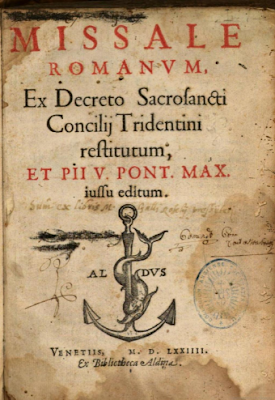
The 1570 Roman Missal, which defined Catholic Mass until the 1960s - including the Ash Wednesday ceremony
Local traditions still meant that there was considerable variation in the Ash Wednesday rites across the Christian world. Eventually Pope Pius V’s (the same Pope who declared Elizabeth I a heretic, and whose body is still on display in Santa Maria Maggiore in Rome) Roman Missal of 1570 tackled the differences by standardising them into a single ritual for the prayers, practices and music involved. In fact it standardised the celebration of the Mass generally in the wake of the Council of Trent (defining what became known as the Tridentine Mass), but as part of that it dealt with Ash Wednesday as well. Those things you recognise – the sign of the cross on the forehead, that Latin phrase about being dust, the need to wear the ashes all day – were all regularised in 1570, as were various other behind-the-scenes procedures.
