
The History Of Mental Institutions In Donegal
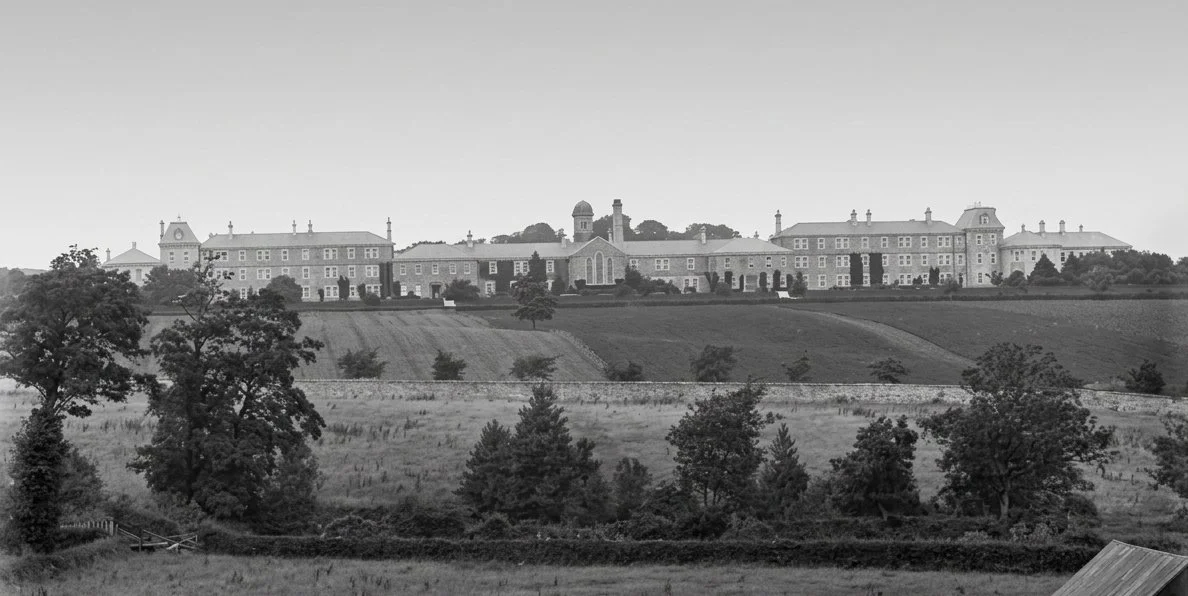
St Conal’s Hospital, Letterkenny, around 1900
I had known that the history of mental institutions in Ireland raised some disturbing questions, but only recently did I start to dig around to see how Donegal was affected, and whether the county – often out of step with the rest of the country, for good or ill – had a history that was better or worse that the broader Irish one.
It might not be worse, but given how bad things were nationally, that’s scant consolation. Shockingly, Ireland was, in the mid‑20th century, the most institutionalised society in the world, with confinement used as much for social control as for treatment. Across the century, thousands passed through the wards of St Conal’s in Letterkenny, many never to return to society, a significant number ending in unmarked graves at St Conal’s and Leck Cemeteries.
St Conal’s opened in 1866 as the Donegal District Lunatic Asylum (even the language is shocking these days – as you read more, the difference in attitudes between today and a century ago seemed harder and harder to bridge) with space for 300 patients. But it was quickly overwhelmed: by the early 1900s, it held around 600 people, prompting major extensions, and at its mid‑century peak about 800 patients were confined there together. Nationally, Ireland’s asylums grew from about 3,000 inmates in the mid‑19th century to 21,000 by 1956, by which point the country had more psychiatric beds per capita than any other country in the world.
Compared with much of Europe, Ireland used large custodial asylums for longer and more widely. The committal process shows how so many people could simply be removed from ordinary life. For most of the period, the key legislation was the Dangerous Lunatics Acts of 1838 and 1867, which allowed a person to be declared a “dangerous lunatic” and confined on the basis of a sworn complaint (by anyone). Little “evidence” was required: an informant swore that someone was deranged or threatening (unbelievably, sometimes having a funny look or walking in the roads were considered good reason…and “dangerous” was interpreted loosely enough to include being noisy); a local doctor, often relying on hearsay, certified that the person appeared of unsound mind; and two justices of the peace or a district justice (who, not being experts, normally deferred to the doctor) then signed the committal.
Crucially, the individual had no right to legal representation, no opportunity to challenge their accusers, and no meaningful chance to speak in their own defence; if they resisted, their behaviour was taken as further proof of insanity. Once the paperwork arrived at St Conal’s, the Resident Medical Superintendent actually had no legal power to refuse admission, presumably accepting many people whose mental health he believed to be sound.
Behind this process was a social logic that was somewhat shame-based, and sometimes greedy. Families and neighbours initiated most cases, not psychiatrists. Genuine mental illness and disorders certainly appeared in case notes, but so did poverty, intellectual disability, eccentricity and behaviours that were just “odd”. In a land-hungry society, an elderly parent or troublesome sibling could be removed as an obstacle to an inheritance under the guise of public safety. Unmarried pregnant women and “wayward” teenagers might be diagnosed with “moral insanity” or “melancholia” and committed when families sought permanent disappearance (rather than the similarly cruel but more time‑limited mother‑and‑baby homes). Gardaí enforced the rules, physically removing people from their own lives in marked vehicles, sometimes in cruelly public spectacles.
Once inside, the prospects of release were slim, especially if families refused to take people back. The law did not quite require family consent for discharge, but superintendents were reluctant to release patients without a home for them to go to. Patients often remained for decades, not because of actual illness but because they had nowhere to go and no institutional ally to press their case. Letters were intercepted, appeals were rare, and the Inspector of Lunacy (yes, an actual job title) tended to focus on numbers and sanitation rather than the justice of individual committals. The result was a system with little incentive to reduce numbers, and no local officer with the authority to pursue release.
Even death did not break the pattern. By 1902, over 1,000 people who died in St Conal’s were buried in a graveyard on the grounds, almost always without individual markers. After that, burials moved to an “asylum plot” in Leck, where up to 500 patients were buried, again mostly unmarked. Families frequently chose not to claim bodies, fearing the stigma of publicly acknowledging a relative from “the madhouse,” and patchy records mean the true numbers may be higher. (Locally, heritage projects and media features have begun to reshape how St Conal’s is remembered. At Leck, a stone memorial now acknowledges the hundreds buried there who were once hidden by society from society.)
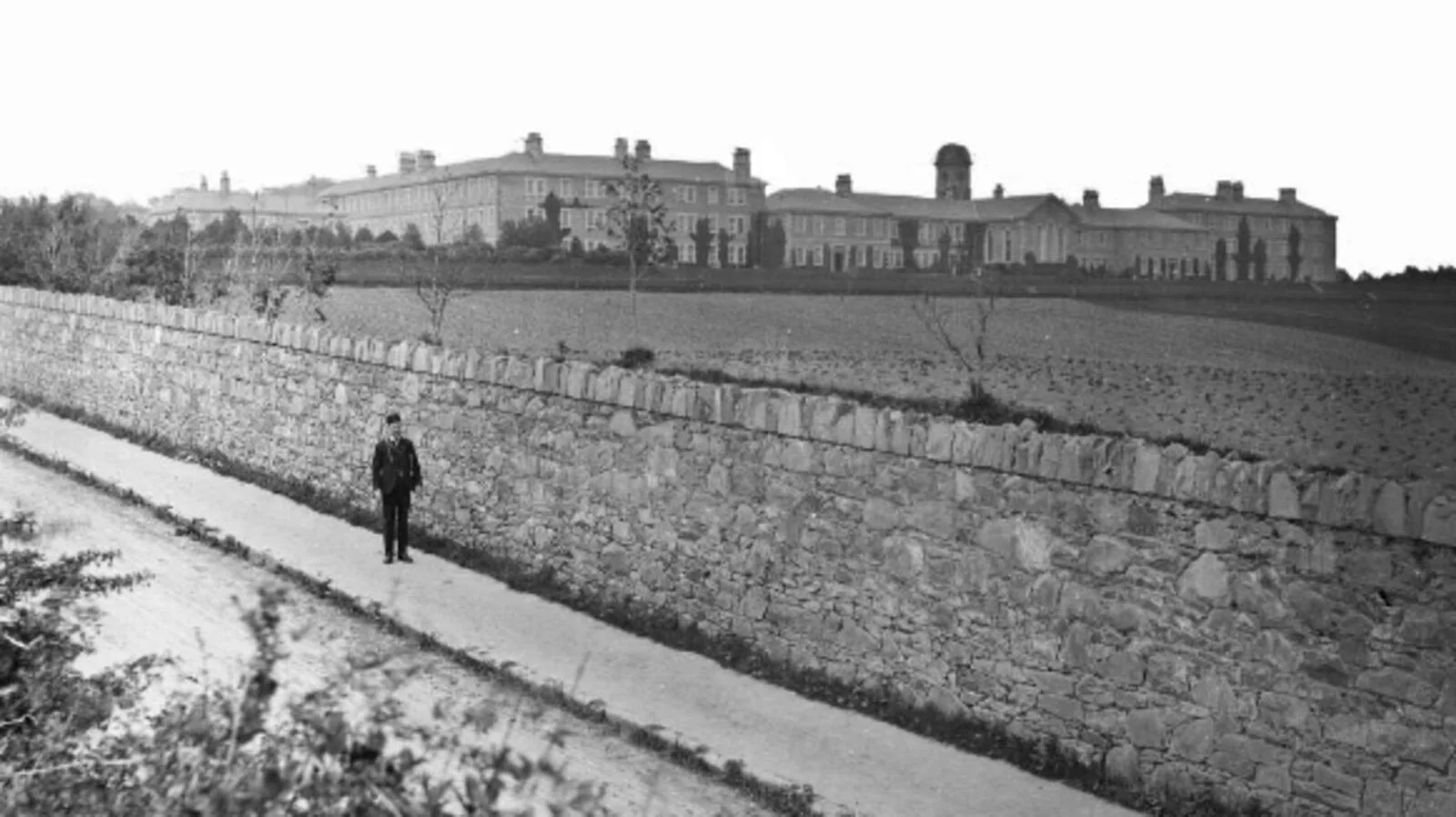
The (safer) view from outside
Eventually, the Mental Treatment Act of 1945 attempted reform, but it was half-hearted. It introduced the idea of “voluntary” patients, though in reality many “voluntary” admissions were coerced by families; new “temporary” stays sounded promising but were routinely renewed for years; and while there was now a chance to appeal, the process was slow and rarely effective. In Donegal, as elsewhere, families, doctors and magistrates could still conspire to move vulnerable people into asylums and, to some degree, just forget about them.
Life inside St Conal’s, as elsewhere, combined custodial control with grey conditions and heavy labour. Overcrowded wards, limited treatment options and a culture that sought docility rather than recovery made the hospital more prison than clinic. The hospital farm, worked by patients, shaped daily routine: it was called “occupational therapy” but it was unpaid labour, helping to keep the institution economically self‑sufficient. This was also another incentive to retain able‑bodied, “harmless” inmates who were useful on the farm. Some patients did benefit, and were discharged, sometimes on a trial basis; but many spent their adult lives within the walls.
It’s important to say that, early on at least, Ireland was not alone in its attitudes: in many countries, similar problems were often dealt with in similar ways. But Ireland was at the extreme end of it, with confinement rates beyond any other country, even the likes of the USSR which was internationally notorious for its own confinements. But in the mid-20th century, as other countries began to adopt more therapeutic and compassionate treatments, and to include community care, Ireland continued its draconian ways. The horrors of WWII had shocked countries into rethinking their attitudes to mass detention and the infallibility of medical or psychiatric experts: this new global discussion of human rights and bodily autonomy eventually produced the 1948 UN Declaration of Human Rights.
But incredibly, it was at this very moment that Irish institutionalisation was peaking. Ireland was moving in the opposite direction from the rest of Western Europe at exactly the moment when it should have been most aware. Several reasons have been offered for this: Ireland's neutrality, and the tight censorship of the wartime press here, created a blind spot that meant the news about concentration camps simply did not penetrate here the way it did elsewhere; and the Catholic Church, still in the ascendant here at the time, consistently framed the institutions as protective rather than punitive, charity rather than confinement. In truth, too, it’s likely that the governments of the day, which funded the asylums, were just reluctant to acknowledge the dark parallels which were obvious to any neutral observer.
The reform that did eventually come to Ireland — the 1966 Commission, the 1984 Planning for the Future document, the 2001 Act — emerged less from human rights than from economics-based deinstitutionalisation movements elsewhere, from the flexibility of new antipsychotic drugs, and from debates within Irish psychiatry itself. The moral argument arrived late. Official responses have been slow (the 1966 Commission acknowledged Ireland’s high confinements rates and dubious committals but didn’t trigger any immediate changes), but from the 1960s asylums were gradually downsized and closed. New national policy was eventually published in A Vision for Change (2006), which committed the state to more holistic, community‑based mental health services. St Conal’s closed its wards in 2010, and the old buildings were partly incorporated into Letterkenny University Hospital and other services. Unlike the Magdalene laundries or mother‑and‑baby homes, there has been no dedicated national inquiry focused on psychiatric hospitals.
