
The History Of May Day
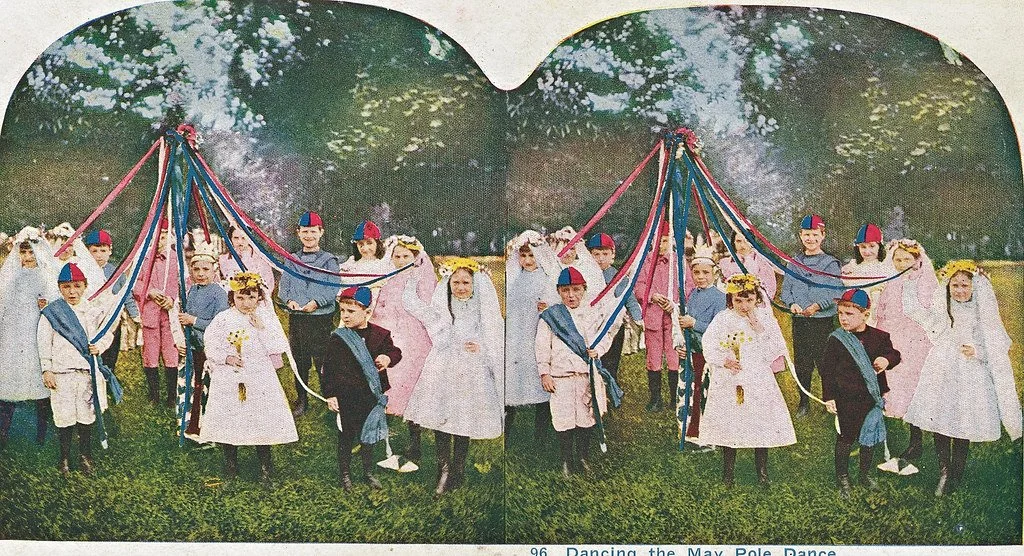
The traditional maypole dancers
These days May Day is a largely secular event, a welcome pre-summer day off for workers; May 1st is celebrated as International Workers' Day across Europe, though since 1994 Ireland has held the first Monday of May as the official public holiday. But the older histories are never far away, even if you’re more likely to see them on the telly than on your own street: children across Britain and America dancing with coloured ribbons around a wooden pole are the most obvious relic. What was all that about?
Actually, even long before anyone danced around a pole, the Celtic peoples of Ireland, Wales, Scotland, and the Isle of Man marked the first of May with Beltane — a festival whose name likely derives from the Old Irish Bel-tene, meaning "bright fire," possibly linked to Belenus, a Celtic solar deity associated with light and healing. Beltane fell at the midpoint between the spring equinox and the summer solstice, marking the beginning of the summer season when cattle were driven to high pastures.
The centrepiece was fire — and not just for warmth or spectacle. Druids would light two bonfires side by side on a hilltop, and the entire community, having extinguished their household hearths, would relight them from these communal bonfires. Their livestock would also be driven between them, the smoke and heat believed to purify the animals and protect them from disease and malevolent spirits before the summer grazing season began. People would also leap over the dying embers to ensure personal health, fertility, or a successful marriage in the coming year.
While fire dominated the heights, the valleys were decorated with yellow flowers (like primrose, rowan, and marigold) which mirrored the sun. These were placed at doorways and windows to protect the home. Beltane was also considered one of the year’s liminal times (the others being Imbolc, Samhain, and Lughnasadh), when the veil between the human and supernatural worlds grew thin and Aos Sí (the fairies) were particularly active. Tradition was that nothing should be lent or given away on Beltane—especially fire, salt, or water—as doing so was seen as handing over the "luck" of the household to the spirits for the rest of the season.
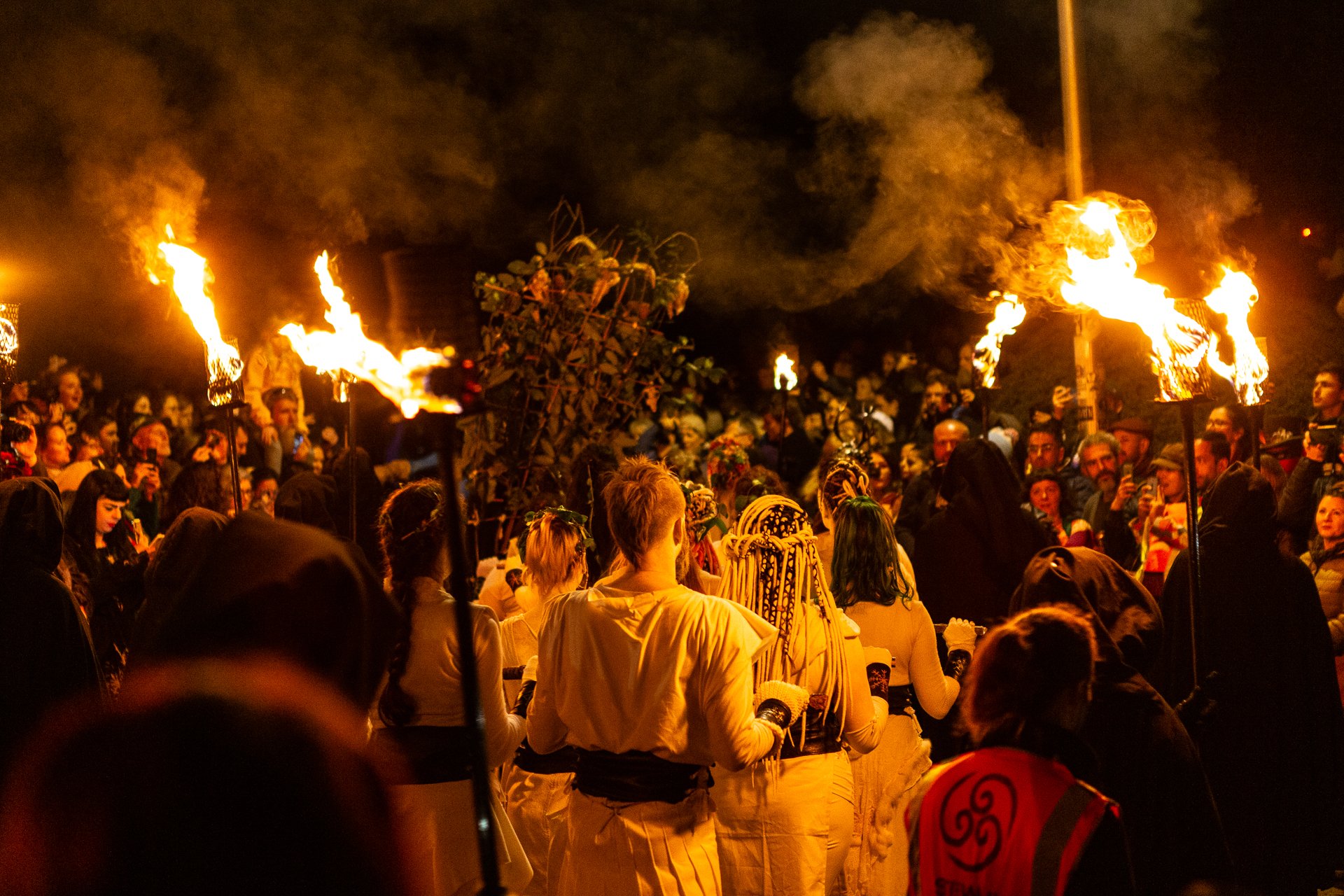
Beltane Festival - procession of the May Queen
Meanwhile, the Romans were celebrating the Floralia from late April into early May: a festival dedicated to Flora, goddess of flowers, spring, and fertility. Unlike the austere rituals of the Celts, the Floralia was downright rowdy, with theatre, the release of hares and goats as symbols of fertility, and the scattering of beans and flowers among crowds. When Rome occupied Britain, these two different spring traditions began to merge, eventually becoming the "Merry England" celebrations of the Middle Ages.
The most obvious symbol of the May Day traditions is the maypole – but its origins are a little murky (pagan traditions left few written records). Some historians believe the practice began in Germany more than two thousand years ago and spread into Roman Britain as an annual fertility rite. Others point to the Floralia, during which Romans danced around trees stripped of their branches and draped in ivy and flowers.
In its earliest days, the maypole was a living tree — typically birch or hawthorn — felled in the forest on May Eve in a tradition known as "Going A-Maying." Young men and women would head out at midnight, strip the tree of its branches, decorate it with wreaths and ribbons, and drag it back to erect in the village centre. Symbolically, the pole was both the “axis mundi” (the point where heaven and earth meet) and a phallic emblem of masculine solar energy, with the encircling dancers representing the fertile earth; the interwoven dance supposedly represented communal interdependence. By the Middle Ages, maypole dances were common across Europe. The ribbon-weaving around the maypole, incidentally, may be a much later invention: some historians believe it was established or formalised during a revival of folk traditions in late 19th-century Britain, rather than being an ancient practice.
By medieval England, May Day had evolved into a holiday for the working classes. Two figures came to embody the day: the May Queen, usually a young woman crowned with flowers who personified the purity and potential of the new season, and the Green Man (usually depicted as a face in a mask of leaves) who represented the untamed spirit of the forest coming back to life. In some places these figures merged with the legends of Robin Hood: since May Day was a holiday for common people, the outlaw who stole from the rich became the "King of the May," temporarily upending the social order.

The Green Man
In the 17th century the Puritans were – predictably enough – not very amused. They viewed the maypole as a "stinking idol": a pagan relic that encouraged debauchery and excess. In 1644, the British Parliament under Oliver Cromwell banned maypoles; the Restoration of Charles II in 1660 brought them back as a symbol of the return to traditional festive life.
In the young America the tension – yes, those Puritans again – had already come to a head. Thomas Morton, a lawyer who had established a colony in what is now Massachusetts in 1624, erected a maypole on May 1, 1627, to celebrate renaming his settlement "Merrymount." He invited both English settlers and neighbouring Native Americans to join the fun — an act that horrified the Puritans of Plymouth. The following year, Plymouth's military commander Myles Standish arrested Morton and shipped him back to England.
Unexpectedly, though, Morton's defiance helped establish May 1st as a date of resistance in American consciousness. That notion continued quietly until May 1, 1886, when hundreds of thousands of American workers launched a general strike demanding an eight-hour workday. The strike culminated in the Haymarket Affair in Chicago, a labour rally that turned violent, resulting in deaths on both sides and the subsequent execution of several labour organisers in proceedings widely condemned as unjust. In 1889, the International Socialist Conference declared May 1st International Workers' Day in their memory. Today, May Day as a workers' holiday is observed across much of the world — though the US, where the modern movement was born, officially marks Labour Day in September instead, a deliberate distancing from the early radical associations of May 1st.
