
A Short History Of Solar Eclipses In Ireland
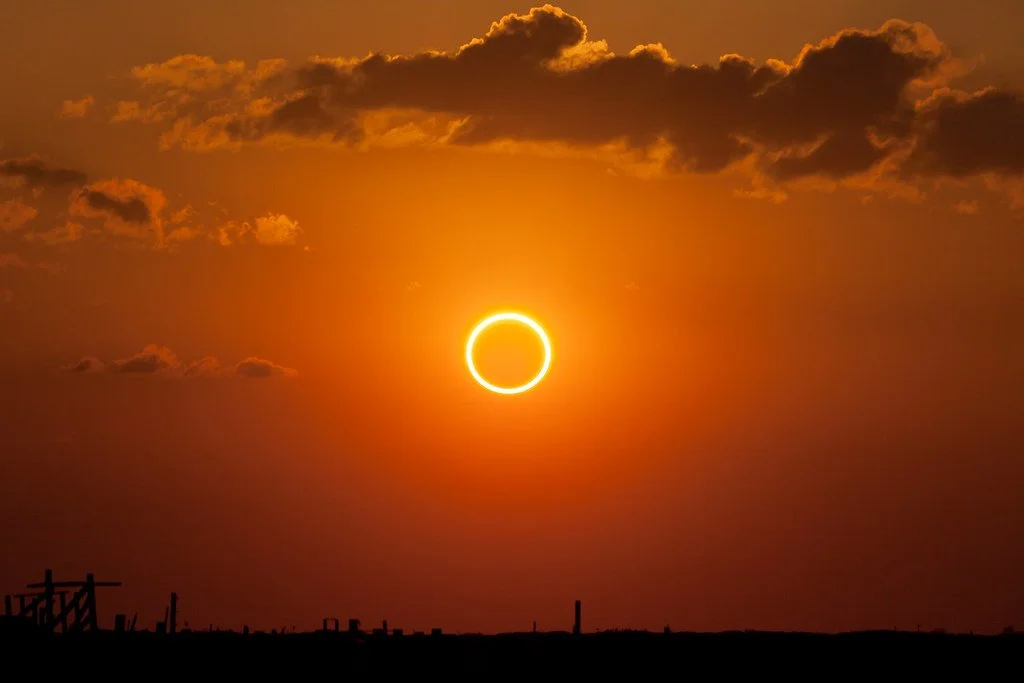
Presumably, few celestial events can match the disorienting power of a total solar eclipse. I mean, it seems that way to me, but, being Irish, it’s hard to imagine a sky clear enough to actually watch one; I remember the 1999 one (and the older generation’s warnings of “it’ll not brighten up again after that one!”), and while it was no doubt spectacular if you could see it, here on the ground it was just another dim grey day.
Before we understood orbital mechanics, though, no doubt the sudden swallowing of the sun and the darkening of the sky must have looked like some kind of cosmic warning or emergency. Even yet the specific arrangements almost look too perfect to be a coincidence: the sun is 400 times larger than the moon, but it just so happens to be 400 times further away, so the moon covers it like a lid fits a pot. So in Ireland, a land still marked by megalithic astronomy and full of Gaelic myth, of course eclipses were remarked on.
The Devouring Monster
In most pre-modern civilizations, the sudden darkness provoked dread and confusion. Many cultures imagined a celestial predator was consuming the sun (which was presumably hotter than the cheese centre in a fresh toastie). In Hindu mythology, the demon Rahu drinks the gods' elixir of immortality and is beheaded for it; his severed head continues to chase the sun across the sky, and an eclipse occurs when he briefly catches it. In China and Vietnam, a dragon or giant frog was said to be devouring the sun, and communities would bang drums and pots to frighten the creature into releasing it. Elsewhere (Mesoamerica, the Near East) eclipses were read as signs of divine anger, or a conflict between gods of light and darkness.
Ancient Irish reactions were formed by a mix of pagan folklore and Christian beliefs. In Irish mythology the sky was always populated by the Tuatha Dé Danann and other volatile forces. Light and kingship were bound together in the Irish imagination: a healthy sun was often taken as a sign of a rightful king and a flourishing land, while its failure could be read as an omen of a corrupt reign or a blighted country.
That connection surfaces in the myth of Dowth, one of the passage tombs of the Boyne Valley. According to the medieval Dindsenchas (the lore of places), the king Bresal wanted a tower built tall enough to reach the heavens in a single day. His sister, a druidess, cast a spell to hold the sun motionless so the work could continue without the interruption of nightfall — until Bresal forced himself on her and broke the spell. The sun fell abruptly, darkness swallowed the site, and the labourers scattered mid-construction. The name Dowth is traditionally linked to Dubhadh, "the darkening." Some archaeoastronomers have proposed this tale as a folk memory of a real eclipse witnessed near the monument's construction.
There’s another contested claim that spiral carvings inside nearby Loughcrew's Cairn L record a specific eclipse from 3340 BCE. That theory, first proposed by archaeoastronomer Paul Griffin in 1999, would make it possibly the oldest depiction of an eclipse anywhere in the world, though other researchers who have examined the same carvings have not read them as eclipse records at all. It's a lovely possibility, though not a proven one.
Irish folk belief more broadly treated sudden, unnatural disruptions to the sky and land as moments when the boundary between the human world and the Otherworld grew thin — the same logic that made dusk, birth, and other transitions dangerous times when the Sídhe (the fairy folk) were thought to be especially active and humans more vulnerable.
Historical Solar Eclipses
Historically, Irish eclipses have also been documented in the annals often kept by monks.
One of Ireland's earliest surviving written eclipse records appears in the Annals of Inisfallen, which note simply an eclipse of the sun in the morning of 23/7/594 CE. The Annals of Ulster record the same event (although incorrectly dated) as a "dark morning”. Modern reconstructions show the path of totality running from Galway across the midlands toward Belfast and on into Scotland, meaning many early Christian settlements across the island experienced the sudden midday darkness.
The Annals of Ulster mark 1/5/664 CE with the entry "darkness on the Kalends of May… at the ninth hour" (late afternoon). Astronomers have confirmed a near-total eclipse was indeed visible over Ireland and Britain that day. It was made more memorable by what followed: the same annals record that plague reached Ireland that August, and the illness (remembered as the Yellow Plague) went on to kill two kings of Ireland among many others, devastating monastic communities across the country. Appearing within months of each other, the eclipse and the plague were easily read by contemporaries as connected signs of a single divine judgment.
The annals continued to log eclipses for centuries afterward — 688, 753, 763, and a short total eclipse on 1 January 865 among them — turning the sky into a kind of parallel chronology that scribes (and even modern historians) used to cross-reference historical timelines. Eclipse imagery even entered heroic literature: several medieval manuscripts, including the Book of Leinster, associate a sudden darkening of the sky with the death of the Ulster king Conchobar mac Nessa, linking a legendary ruler's downfall to the same kind of cosmic disruption the annals recorded as fact.
Dúngal
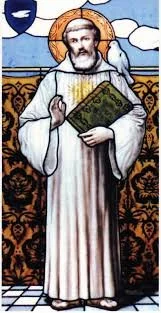
Irish minds worked on the subject even outside of Ireland. In 810 CE, Dúngal of Saint-Denis, an expatriate Irish monk and astronomer, made one of the earliest scientific predictions of an eclipse. The court of Charlemagne had become anxious over reports of an impending double solar eclipse, and turned to Dúngal for answers. Using astronomical calculations derived from classical texts, and his own observations of planetary motion, Dúngal showed that such events were predictable and natural, rather than signs of divine wrath or war. Dúngal’s work bridged ancient scientific knowledge with early medieval thought, cementing the reputation of Irish scholars abroad.
Irish chroniclers and bards were not shy about using eclipses retroactively either. If a king died or a battle was lost near the date of a recorded eclipse, later annalists were liable to frame the darkened sun as a portent; or, conversely, a ruler who survived a dark day unscathed could have that survival read as a mark of divine favour.
Rather than being frightened now, though, we should perhaps be grateful: our views of total solar eclipse are a cosmic coincidence. Billions of years ago, the Moon was much closer to Earth and much larger in the sky, and these days it’s steadily receding at a rate of about 3.8 centimetres each year. As it drifts further away, its apparent size will shrink until it cannot fully cover the sun. We’re here in the only age of total solar eclipses the planet will see. Although we’re still perfectly justified in shaking our fists at the inevitable grey cloud cover every time.
