
666 And All That…The Number Of What Beast?
How the number lives in our heads
Few numbers have inspired as much fear as 666. It has appeared in horror films (it was with The Omen in the 1970s that the widespread modern fear really began), conspiracy theories, evangelical prophecy books, heavy metal album covers and urban legends. Even now, in 2026, it’s seen by many almost as synonymous with Satan himself.
Inevitably, the historical origins of 666 are far less supernatural than popular culture suggests – and more misunderstood even in the smallest detail. Far from being a mysterious "number of the Devil" or a prophecy about end times, it began life as a piece of coded political criticism, written at a time when openly attacking the Roman Empire could be fatal. But while code might have been essential at the time for anyone criticising the Emperor, it has left the subject wide open for misinterpretation over the last two millennia or so.
666 appears only once in the New Testament, in the Book of Revelation, traditionally attributed to John of Patmos. In Revelation 13:18, readers are told: "Let anyone with understanding calculate the number of the Beast, for it is the number of a man. That number is 666."
Two things are interesting here. Firstly, it specifically says the Beast is not a supernatural/demonic being, but “a man.” Secondly, rather than presenting 666 as a cursed number, it invites readers to calculate it. The implication is that it is a code waiting to be solved (it also gives the lie to the idea that 666 itself is the mark of the Beast: it is just the number to help us identify the Beast).
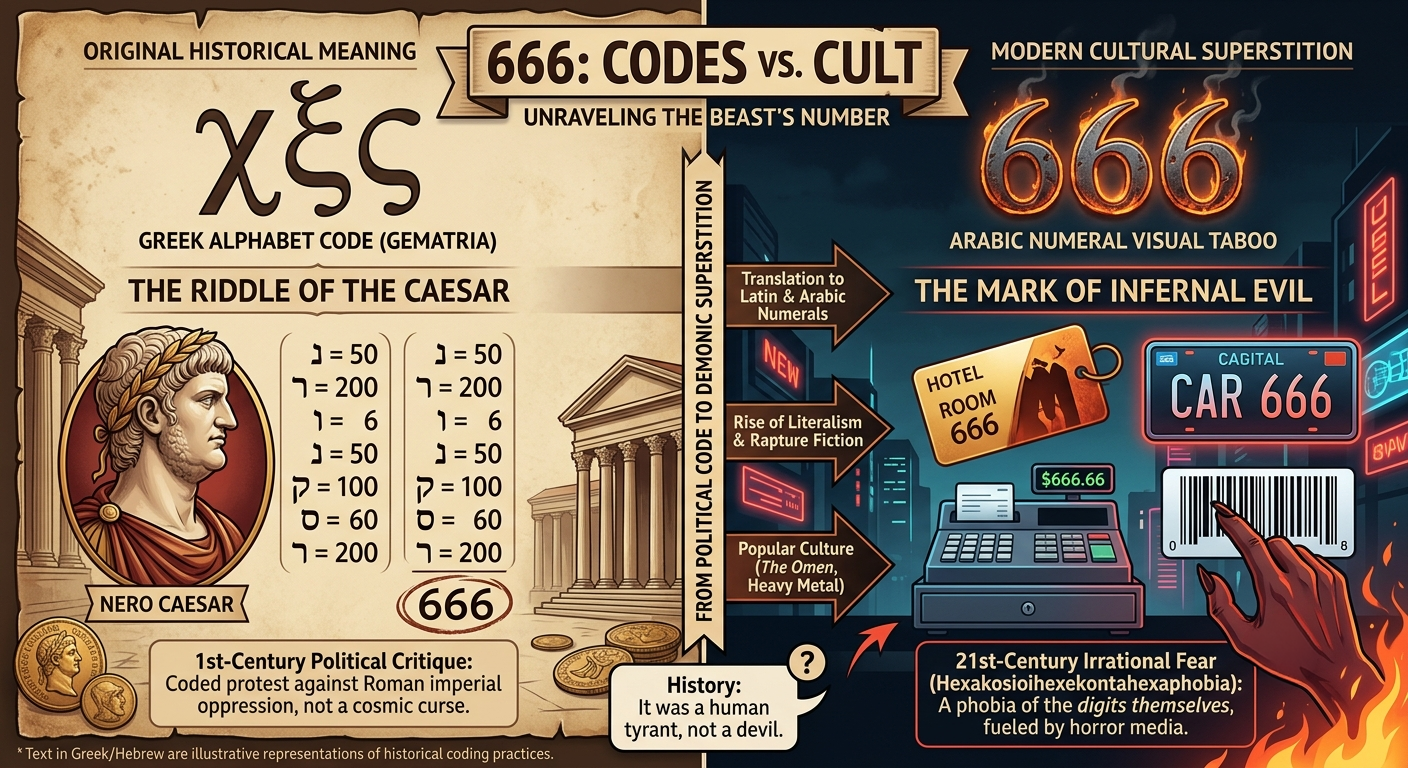
To understand how this worked, it helps to know that ancient Greek and Hebrew did not use separate symbols for numbers: one symbol would serve double duty as both. Every name therefore possessed a numerical value obtained by adding the values of its letters together. This seems obscure here and now, but it was common throughout the ancient Mediterranean. In Hebrew it is known as gematria, while the Greek equivalent is called isopsephy. It was used in riddles, poetry, inscriptions and even graffiti. Writers sometimes referred to people indirectly with the numerical value of their names (you can still see it used in perfectly ordinary graffiti: “I love her whose name is 545” in Pompeii, for example).
To a first-century audience, Revelation's challenge to "calculate the number" would have been immediately recognisable; it just looks intimidating to us. Most historians and biblical scholars believe it points to the Roman emperor Nero, who ruled from AD 54 to 68. Nero became infamous in later Christian tradition as the first emperor to persecute Christians following the Great Fire of Rome in AD 64. The extent of the persecution is debated nowadays, but the point is that Nero became the archetype of the cruel tyrant and was remembered as an enemy of the early Church. And when the title "Neron Kaisar" is written in Hebrew, the numerical values add up neatly to 666.
This is why Revelation calls it "the number of a man." It’s not pointing us towards the supernatural, just a specific human. Nero is not the only possible interpretation, but he’s widely regarded as the likeliest because he fits both the historical context and the mathematics of gematria. He also fits the odd case of early copies of Revelation, which claimed the number was not 666 but 616. This actually strengthens the Nero claim. If the emperor's name is written in its Latin form, "Nero Caesar," rather than the Greek-influenced version, one Hebrew letter disappears. The missing final "n" has the value of 50. This explains why both numbers circulated in antiquity. Different audiences knew the emperor by slightly different spellings, and the numerical code changed accordingly.
But if it really referred to Nero (or later emperors portrayed as "new Neros"), why not just say so? Survival. Revelation is full of symbolic language, Beasts, dragons, and monsters: coded imagery that allowed Christians living under Roman authority to criticise it without being explicitly treasonous. Calling the emperor a Beast destined for divine judgement was dangerous – Nero had burned people for less – and hiding his identity behind a numerical riddle at least gave some plausible deniability.
The number was never even "the number of Satan" but "the number of the Beast." In Revelation, the Dragon (usually interpreted as Satan) and the Beast are distinct figures (the Beast represents earthly power aligned against God). Over time they merged in popular imagination until the number became associated directly with the Devil - but that was driven mainly by later tradition and modern popular culture.
The "Mark of the Beast"
Revelation 13:16-17 states: "He causes all, both small and great, rich and poor, free and slave, to receive a mark on their right hand or on their forehead, so that no one can buy or sell unless he has the mark, that is, the name of the Beast or the number of its name." This is a connected but different concept to the Number of the Beast - it’s some outward sign of loyalty which may be a name or a number. The film The Omen had 666 as both number and mark, and made that mark a birthmark on the child, Damien.
Modern popular culture, being more prone to paranoid conspiracies, often imagines the Mark as a tattoo, implanted microchip or biometric identifier…or various other everyday things. But original readers understood something different. The Greek word translated as "mark" (charagma) referred to official stamps, seals, coins or brands that signified ownership or authority: like the Roman coins bearing the emperor's image, or Roman seals authorising documents or expressing ownership. These were “legal tender”, which you would hold in your hand, and which allowed people to formally conduct business in the Empire. Symbolically, therefore, the “mark" represented participation in the political and economic system of those times, not a prediction of twenty-first century technology.
But as time passed and knowledge of history and ancient numerology faded, Revelation became increasingly mysterious to readers. During the Middle Ages, many Christians interpreted the Beast not as Nero but as whichever political or religious enemy they opposed. Popes, kings, reformers and rival churches were all identified as the Beast at various times. The invention of printing allowed this speculation to spread rapidly, widely. From the nineteenth century, new theological movements encouraged believers to expect an actual future Mark of the Beast (and to interpret it as the sign of oppression, if not the anti-Christ).
Various technological innovations thereafter became candidates. The best-known example concerns supermarket barcodes: during the 1970s and 1980s, a theory arose (in 1981 Mary Stewart Relfe published a book called The New Money System 666, a bestseller in evangelical circles) that claimed that the three elongated "guard bars" found in barcodes represented 666. They were, after all, a mark, and were involved in buying and selling. The claim gained considerable attention in parts of the evangelical world, and still circulates today…even though it’s not true. Barcodes just use “guard bars” to tell scanners where the barcode begins and ends. They look at first glance like the bars used to represent 6 - but they are not sixes, and are distinguished by their length, their placing and the spaces around them. They are simple structural bars, read only as “start/stop reading” prompts.
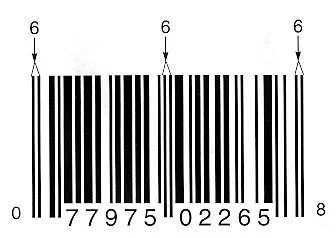
A barcode showing the extra length and detachment of the guard bars.
But never let facts get in the way of fear. The idea also helped establish a recurring panic about new technologies (seen through the lens of Revelation). We’ve seen the same attacks on RFID chips in passports and payment cards, COVID vaccination certificates, digital wallets, and QR codes. Each has been portrayed as the “mark” that tracks our every move and changes how we buy, sell or identify ourselves (the fear seems to operate partly on the basis that the Beast, powerful enough to oppress us all and perhaps attempt to overthrow God, is too stupid to cover his own tracks).
Sure What’s The Harm?
When a superstition like the fear of 666 (widespread enough to warrant its own name: hexakosioihexekontahexaphobia) is challenged, people often offer some version of the argument that it costs nothing to believe, and it’s better to be safe. But while 666 has no supernatural power, belief in it has tangible consequences. Not all of it is major or obvious, granted; as a relatively trivial but widespread example, I can tell you from my own experience that people often avoid numbers like car registrations that have 666 in them (some licensing authorities around the world actively avoid the number). And in retail transactions, when a total reaches €6.66 (or even something that looks like it – say, €66.60) purchases are often abandoned or cashiers must pause and wait for an anxious customer to find another item to add to the bill. Online, automated pricing algorithms that accidentally price an item at exactly €66.60 or €6.66 sometimes cause sudden drops in completion rates as superstitious buyers abandon their carts.
Economists call this an efficiency tax: people refusing to interact with a specific sequence of numbers, systems being altered to accommodate them. That’s OK if you’re buying a pack of mints just to modify your total bill, but if a government changes public infrastructure due to superstition, taxpayers foot the bill. In America, Highway 666 had to be renamed to 491, meaning the Federal government and the states of New Mexico, Colorado, and Utah had to fund the manufacturing and installation of hundreds of new metal highway signs, and every local map, emergency system, and highway database had to be updated, costing hundreds of thousands of dollars in unnecessary work. Meanwhile, in some states, if a customer objects to 666 on their registration plates, those plates are replaced at the state's expense.
In the corporate world, hard as it is to feel sympathy at times, 666 damages the bottom line too. Properties with 666 in their address frequently take longer to sell, at lower prices. Alternatively, owners must pay for an address change (as Ronald Reagan once did, renumbering his Bel Air home address to 668 Cloud Road at state expense). In high-rises, developers occasionally have to offer rent discounts or spend extra money rebranding the 66th floor to attract corporate tenants with superstitious executives or clients. Relabelling elevators, updating blueprints, and reregistering floor layouts as "Floor 65B" or "Floor 67" costs time and money. Likewise, consumer brands must sometimes pull or repackage products; when the original Apple-1 computer was released in 1976, for example, Steve Wozniak priced it at $666.66 because it was easy to type – but the religious backlash forced Apple to change its pricing.
And there are personal costs too: the added anxiety, and perhaps some lost opportunities: travellers often cancel trips when they book a flight or seat number 666. Amusingly, though, for a long time Finnair used Flight 666 on routes to Helsinki, airport code HEL. (The last such flight off on Friday 13th October, 2017.)
The Pattern Is The Problem
Perhaps weirdly, the problem is not the value of 666, it’s the repeating-sixes visual pattern. People are upset by being a floor labelled 66, for example, but it’s fine when it’s relabelled as 65B – even though it’s still the 66th floor. And nobody freaks out when confronted with DCLXVI, even though that’s just 666 in Roman numerals; the year 666 CE was written for centuries as DCLXVI, but it passed without the mass hysteria you’d expect these days if the actual digits "666" were used. Publishers often use DCLXVI as a loophole to avoid automatic censorship algorithms or immediate consumer rejection.
The reason is psychological: our brains process symbols first, then concepts. The three repeating loops of 666 have been branded into us by Hollywood and folklore, but we shrug at the same value in a different format. And, just to show how absurd the whole thing is, when Revelation was being written, the modern Hindu-Arabic numeral system did not even exist (it was only popularised by mathematicians like Fibonacci in the 13th century). John of Patmos himself would not even recognise 666 as a number (or anything else). He would have written the value in Greek as: χξς.
We have, it seems, been incredibly unlucky, finally settling, centuries after Revelation, on the one and only pattern out of the infinity of potential patterns that carries such terrible meanings for us.
Who’s Afraid Of The Big Bad Number?
The fear of 666 is far from universal; it’s found almost exclusively inside branches of Christianity, and ignored by most other major faiths. It usually depends on whether the group views Revelation as a literal prediction of future events or a symbolic text about ancient history.
Islam, Judaism, Buddhism, Hinduism, and Sikhism pay no attention to it. The groups most likely to be concerned are the Evangelical, Pentecostal, Charismatic, and Fundamentalist Protestant denominations (particularly in North America, Latin America, and parts of Sub-Saharan Africa). In the late 19th and 20th centuries, these traditions adopted a theological system called Futurism, under which Revelation is treated as a blueprint for coming events, and the "Antichrist" is seen as a literal dictator who will arise during a period of worldwide crisis. For these believers, identifying the "Mark" is a matter of spiritual survival, driving fear of new technologies, government programs, and global politics.
Eastern Orthodox theology is less concerned, but treats Revelation with a degree of caution (it is the only book of the New Testament not read aloud in standard Orthodox liturgies), and popular culture in Orthodox-majority countries is suspicious enough of the concept that in Greece and Russia there have been public protests (often led by monks) against biometric ID cards, electronic passports and social security registration numbers.
For most traditional Christian groups, 666 causes little concern: they generally view Revelation as a 1st-century text written for early Christians. Interestingly, though, there’s a definite informal strain of it in Irish Catholicism, not because the Irish church’s stance is any different (it’s not – it regards fear of 666 as errant) but because over the centuries Irish Catholicism blended with deeply rooted folk superstitions….and these tended to be old Piseoga about avoiding bad luck. Never cut down a fairy tree; avoid magpies; fear the "evil eye". It’s just an extension of the old, inherited, gloomy Irish instinct that it costs nothing to avoid triggering bad luck.
