
A History Of The Old Letterkenny Courthouse
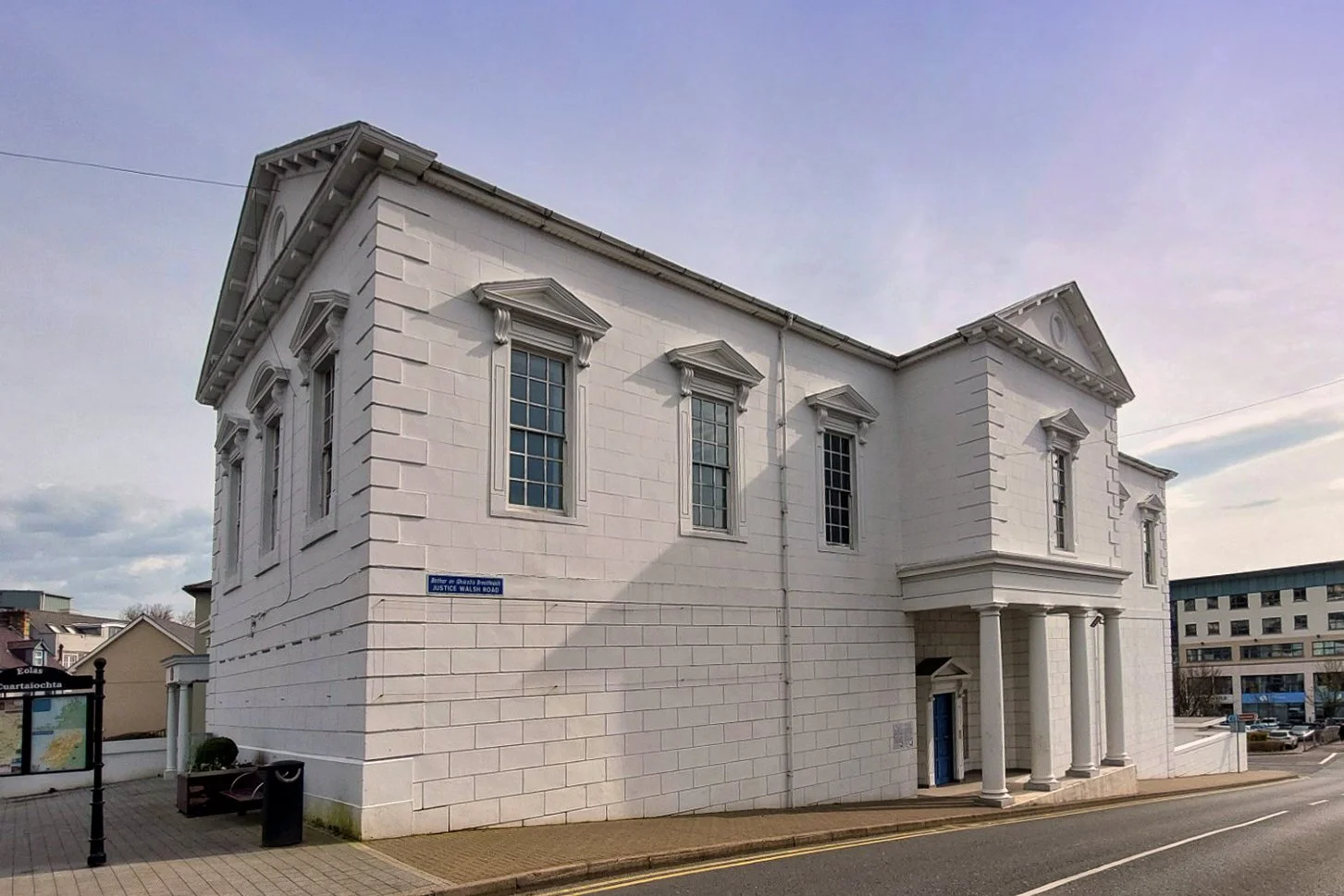
The old Letterkenny Courthouse, constructed circa 1828 to 1831, was designed by Dublin architect John Hargrave. Hargrave was a busy man in early nineteenth century Ireland, engaged by grand juries (forerunners to County Councils) and county authorities across the country to create appropriate, impressive, permanent homes for the British civil administration. As part of that work, his courthouse in Letterkenny was arguably one of the more quietly distinguished public buildings in the Northwest, and perhaps bigger than a town of the size would normally have been granted. Hargrave was paid £60 for the plans, estimates and supervision of the building.
The building is in a Neoclassical style typical of the time in Ireland, with Tuscan pediments to three sides and Tuscan porch to the main entrance. This choice of classical forms was meant to communicate the permanence and weight of British law to a population that had little enough say in how that law affected them. It retains most of its original character, despite some alteration work that began as early as 1840, when a gallery was erected inside by the local architect James McLaughlin. This expanded the building's capacity, and the fact that it was needed so soon reflects the town’s increasing importance as Donegal’s commercial and administrative capital.
For most of the nineteenth century, the courthouse – sited to be sighted as well as cited – served its intended function without much drama. Grand jury sessions, petty sessions, assizes, land disputes, eviction proceedings — all the normal machinery of British law worked through its chambers, presided over by magistrates and judges appointed far from Donegal. The building's bridewell, or holding gaol, adjacent to the main structure, held many of the people who came off less well in its proceedings (the name, bridewell, derives from St Bride's Well, a holy well near Fleet Street in London, where a palace built for Henry VIII was converted in the 1530s into a combined hospital, workhouse, and house of correction for the poor and petty criminals).
The Irish War of Independence, beginning in earnest in 1919, tested the court’s legitimacy. The establishment of Dáil Éireann in January 1919 set in motion a republican state that often ran in parallel (or in competition) with the old British system, and one of its most ambitious expressions was an entirely new court system. The Dáil Courts were formally established in June 1920 by Dáil Éireann, replacing the more limited Sinn Féin arbitration courts that had been authorised by an earlier Dáil decree in June 1919. The 1920 decree created the full tiered structure — Supreme Court, Circuit Courts, District Courts, and Parish Courts – operating under the authority of the republican Minister for Home Affairs, Austin Stack. (Perhaps ironically, while they were intended to replace the British justice system, the courts relied almost exclusively on existing British Common Law.)
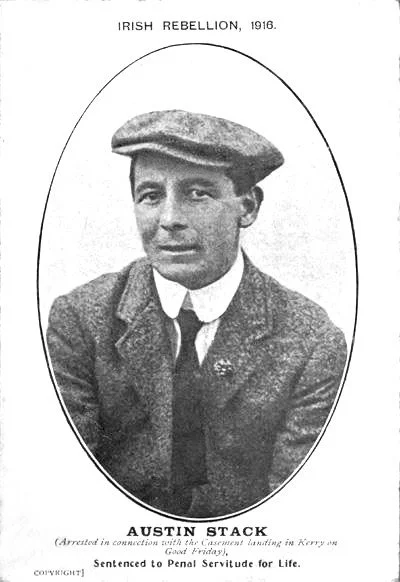
Austin Stack
In County Donegal, touching the border and with a strong British presence, the circumstances were fraught. The Royal Irish Constabulary, under sustained republican pressure, had retreated into the larger towns. Many magistrates had resigned or been removed. The petty sessions system — for land disputes, debts and local grievances — effectively collapsed. In Letterkenny (and elsewhere in Donegal), disputes over livestock, tenancies, and unpaid debts suddenly had nowhere lawful to go through official channels.
The new courts filled this vacuum, drawing their authority from a kind of community legitimacy; local IRA officers, parish priests, and Sinn Féin figures sat as justices. Cases were heard wherever it was safe to hear them: private homes, barns, schoolhouses, back rooms of pubs. The registrars who kept court rolls and administered fines ran serious personal risk. Across Donegal, republican courts were active in Dungloe, Glenties, Bundoran and Killygordon. Courts in Letterkenny operated in secret, keeping sparse written records that could not be seized; the RIC did raid a sitting at Stranorlar but made no arrests, as participants claimed it was only involved in some arbitration (a close call showing the dangerous line these courts walked).
By late 1920, having initially tolerated the Dáil courts, British repression intensified across the county; activists were arrested, including Liam Duffy of Donegal town, who was sentenced to one year's imprisonment for acting as the registrar for the Dáil Court in Donegal. IRA units burned courthouses at Donegal town, Buncrana, and elsewhere to deny their use by the British administration. Letterkenny courthouse was not burned, the concentrated Crown presence here making it a much harder target for the IRA. But under British pressure, the Dáil Courts suffered, and activity fell sharply into early 1921.
The Truce of July 1921 produced a peculiar situation in Letterkenny, with two rival court systems operating simultaneously: one inside the old Hargrave courthouse still under Crown authority, the other republican and meeting wherever it could. The British courts were largely empty, while the republican courts, trusted to deliver fairer justice and rents, were the system most people used. Even among Donegal's Protestant and unionist population, pragmatism brought many before republican justices.
The Civil War, breaking out in 1922, saw the suspension of the Dáil Courts. By late 1922, over 5,000 civil cases across Ireland were unresolved and a judicial commission was established to close them off. In Letterkenny, the old courthouse on Upper Main Street resumed its role as the seat of formal justice, albeit now under the new Irish Free State rather than the Crown. The court system also largely reverted to the pre-1919 British legal system as an interim measure while a new, permanent Irish court system was designed. The Courts of Justice Act 1924 formally established the new courts of the Irish Free State (Supreme Court, High Court, Circuit Court, District Court), which were based on the structure of the British system but were now under Irish authority.
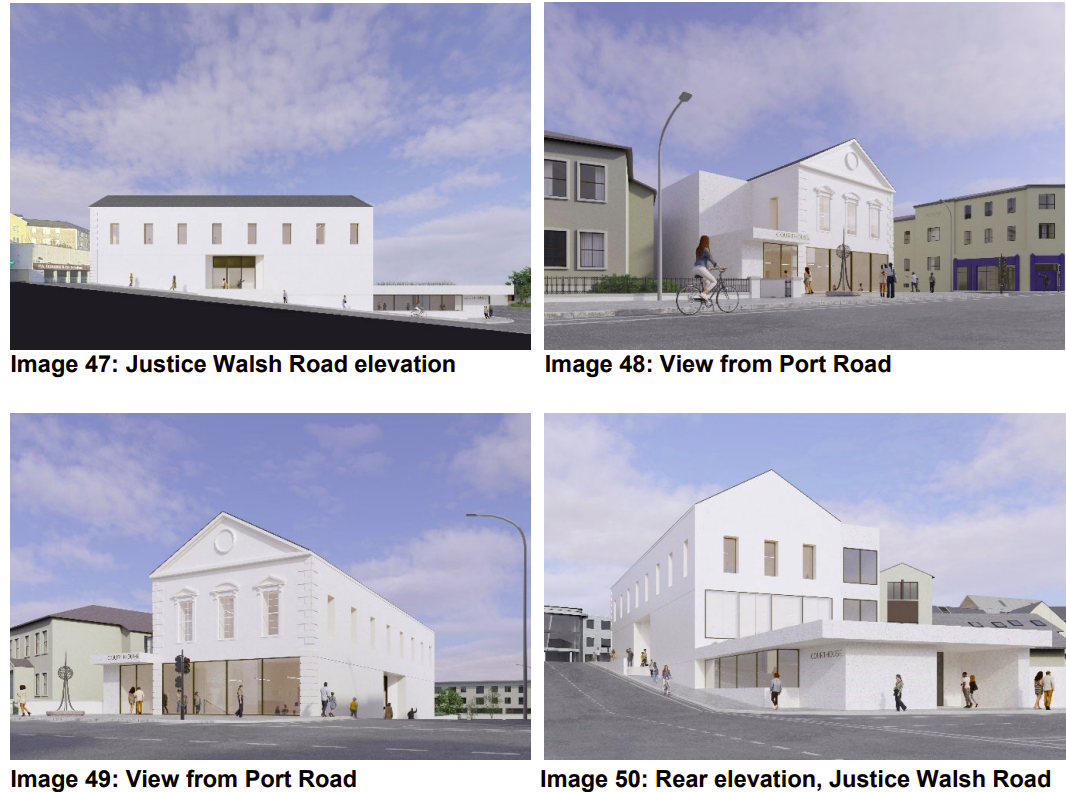
Plans by Robin Lee Architecture
The building served as a courthouse well into the twenty-first century, though modern standards and a growing population meant it was finally replaced in 2018 by the new courthouse on the old swimming pool site. The old courthouse is a protected structure, and there are plans to make significant future use of it. Donegal County Council has received up to €7 million under the Town Centre First Heritage Revival Scheme to redevelop it; the proposed ‘Discover Donegal Centre’ will include tourist information, exhibitions, conferences, art/cultural use, a café, and the inevitable gift shop.
