
WWII: Ireland’s “Emergency”
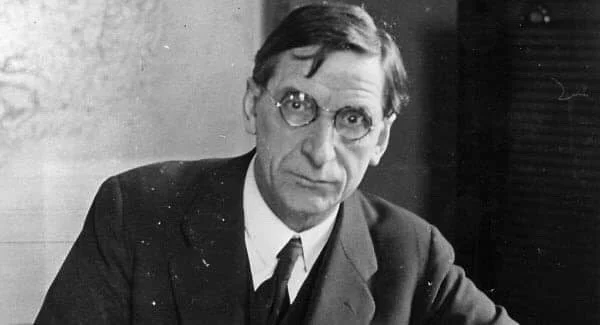
Taoiseach de Valera
When the Second World War broke out in September 1939, Ireland famously did not call it a war: officially, and deliberately, the Irish state referred to it as "The Emergency". It’s sometimes said that Ireland did this just because it did not want to be seen as supporting Britain. But the real answer’s more complicated and more interesting than that.
"The Emergency" was not a euphemism but a specific legal designation. Under Article 28 of the Irish Constitution, the government’s powers were strictly limited unless in a state of war or "armed rebellion." But Ireland wasn't at war. So on 2/9/1939 (the day after the German invasion of Poland) an Amendment was passed to allow a "state of emergency" to be declared if an external war affected the vital interests of the state, even if Ireland was not a participant. A state of emergency granted the government sweeping powers (like press censorship and rationing) while protecting Ireland’s Neutrality – and it was the Neutrality which, for Taoiseach Éamon de Valera, was proof of Irish independence from Britain. Calling it a war potentially raised legal questions about Ireland’s status and the domestic "Emergency Powers". Other countries, like Switzerland, were neutral by long-tested law and international agreements, whereas Ireland, with its new Constitution, was in less sure legal waters at the time; although even so, Switzerland for example usually referred to the war as “the War Years” or “Mobilisation”.
Rationing
Rationing in Ireland is still probably the best-known impact of the war on Ireland. And it was often harsh: unlike the UK, from which it had recently broken, Ireland had no merchant navy, only a tiny fleet that had to dodge both U-boats and Allied mines to bring in essentials.
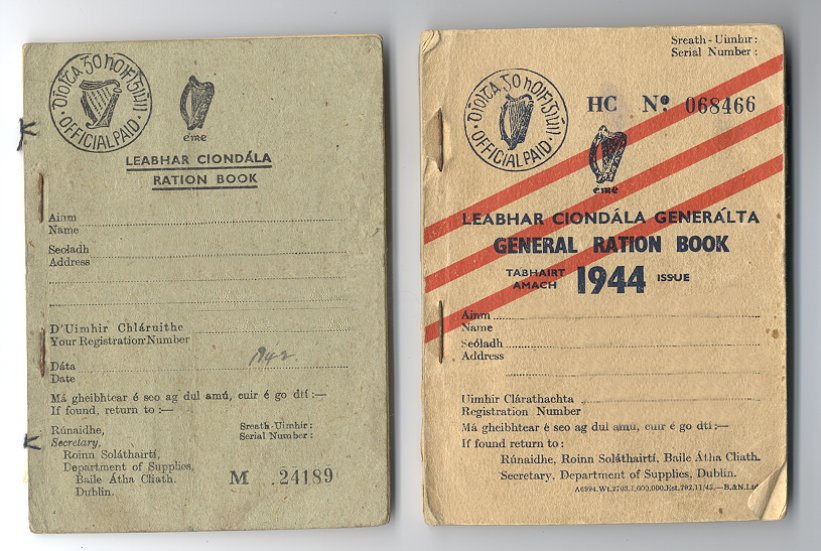
Irish ration books
Tea, while it might be considered something we can live without, was for many the most painful loss. The ration dropped to a half-ounce per week, which provided so little (barely enough for two cups) that people resorted to "stretching" leaves with dried hawthorn or beetroot. "Emergency Bread" was not fun either: a gritty loaf made from high-extraction flour (including the bran and germ) that many found nearly indigestible.
Fuel was the other crisis. With British coal cut off, the "Gas Bolt" (which was used to cut off supplies at a certain time) and the "Glimmer Man" (who checked that people weren’t leaking the slightest bit of light that might attract unwanted attention from the air) became part of urban folklore, enforcing strict hours for cooking. Trains ran on wet turf. Sugar, butter, and soap were controlled via ration books, although all this inevitably led to a black market where a packet of tea could cost a week's wages. Ireland did avoid the starvation seen in mainland Europe, but the rationing era was a hungry time, and lingered well into the 1950s.
Censorship
This is less familiar but in its own way even more extraordinary. Frank Aiken, Minister for the Co-ordination of Defensive Measures, became notorious for overseeing a censorship regime of huge scope and heavy-handedness: his office controlled both the media and private correspondence with a rigidity that bordered on paranoia, beyond anything seen in other countries outside of dictatorships.
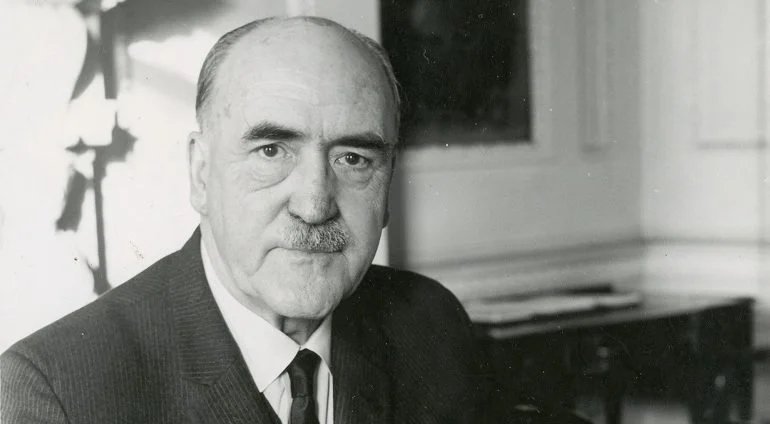
Frank Aiken, censor extraordinaire
Newsreaders were confined to reading, without comment, the bare dispatches of each side. Weather forecasts were forbidden so as not to help anyone’ ships or planes (farmers were not happy). Editors were forbidden from using words like "brave" or "heroic" to describe Allied actions, and films like Charlie Chaplin's The Great Dictator (which mocked one side!) were banned. Even the word "Nazi" was suppressed, as the official position of the German embassy was that its use outside Germany carried an adverse connotation.
Most damagingly, reports of the Holocaust were heavily censored or suppressed. Even when the censorship was lifted in May 1945, Irish people were still conditioned to see the films from Nazi concentration camps as British propaganda. Aiken later admitted he had personally known what was happening in the camps early on. Even official communications from Roosevelt and Eden were stripped of relevant detail.
The underlying rationale was a weird – at this stage unfathomable – Irish moral neutrality: neither side was better or worse than the other, and this was a conflict between powers pursuing their own interests, that good, spiritual Ireland would stand outside of (and of course, above).
Still, the Irish public was rarely as ignorant as the authorities hoped. The BBC, easily heard across most of the country, provided a parallel stream of truthful war reporting that the government could not suppress. Families tuned in to Churchill's speeches while their own newspapers offered sanitised-to-nothing bulletins. When a German aircraft came down in an Irish field, newspapers were often only allowed to report that "an aircraft of unidentified nationality" had come down - a fiction that few people believed, especially when they could stand in the field looking at its swastikas.
The border with Northern Ireland was another access point: thousands of Irish people crossed regularly to work in Belfast's shipyards, picking up information and newspapers in the process. Most people knew something, but nobody was supposed to talk about it.
Meanwhile, the government also used the Emergency to suppress the IRA, which had been attempting to cultivate German support to end Partition. In fact Abwehr, the German intelligence agency, met with the IRA here: the IRA hoped a German invasion of Ireland would help bring about a united Ireland, while the Abwehr thought the IRA could destabilise Britain and distract it from the war in Europe (they even concocted “Plan Kathleen”, which proposed a German seaborne landing at Lough Swilly, and a parachute drop near Belfast, with IRA forces rising simultaneously, but the authorities in Berlin deemed it impractical). Active republicans were interned at the Curragh or given prison sentences (so were German military personnel who ended up here); six men were executed under newly legislated acts of treason, and three more died on hunger strike.
The Donegal Corridor
While Ireland remained officially neutral, it was a neutrality that ultimately tilted towards the Allies. It was a precarious deal, though. In 1938, Britain had returned three deep-water Treaty Ports to Irish control (at Berehaven, Spike Island, and Lough Swilly), having originally retained them because of the U-boat campaign around Irish coasts during World War I. Churchill loudly resented their loss when the Battle of the Atlantic began, and was only prevented from invading Ireland again by President Roosevelt, whose support for the Allied war effort depended partly on the support he himself enjoyed from the vocal and plentiful Irish in America.
But a compromise emerged. In January 1941, de Valera and British representative Sir John Maffey reached an agreement whereby Lough Erne-based flying boats were permitted to fly across a narrow strip of Irish territory from Belleek in County Fermanagh to Ballyshannon in County Donegal, gaining access to the Atlantic Ocean (where they could defend against U-boat attacks). This became known as the Donegal Corridor. It was a major factor in the rest of the war in the Atlantic: among other things, it led to the pinpointing of the battleship Bismarck in 1941 (which led to its destruction) and the capture of U-110, from which the Allies retrieved an Enigma machine and code books which finally allowed them to decrypt German messaging.
The British were also allowed an auxiliary lifeboat service at Killybegs, Co. Donegal, for air-sea rescue purposes, with British sailors required to cover their guns and wear civilian clothes while in port. Ireland also supplied the Allies with detailed Atlantic weather reports – even while the Irish public were forbidden to hear them. A weather report from the lighthouse at Blacksod Bay, County Mayo, prompted the decision to launch the Normandy landings.
The Cranborne Report, compiled around the end of the war for the British War Cabinet, formally acknowledged that the Irish government had been willing to provide any facility that would not be regarded as overtly compromising neutrality – it includes 14 specific points of co-operation.
The Hidden Soldiers
Perhaps the most painful legacy of the Emergency concerned those who felt compelled to actually fight in the war. Almost 5,000 members of the Irish Defence Forces deserted their positions to join combatant nations (mainly Britain), while in total about 80,000 (some sources say 100,000) people from the island of Ireland volunteered without any prior military connection. Between 5,000 and 10,000 died in the war.
When the survivors came home, the state greeted them coldly. The Emergency Powers Order 1945 deprived those former Irish Defense Forces members of pension entitlements and unemployment benefits accrued prior to their desertion, and prohibited them from employment in the public sector for seven years. Their families were often unable to publish proper obituaries for the fallen. Many who returned were ostracised in the communities they had left to protect.
In June 2013, Ireland's Minister for Defence Alan Shatter gave a statement in Dáil Éireann making a formal apology for the government's treatment of these veterans. The 1945 treatment was described as "unduly harsh", though by 2013 barely 100 of the men were still alive to hear it.
