
The History Of The Harp As A Symbol Of Ireland
Ireland is the only country in the world whose national symbol is a musical instrument: it’s on the passport, the presidential seal, the coinage, and (in slightly different form) the pint glass of its most famous stout. But it’s not an immediately obvious logo: how did an instrument that originated at least 5,000 years ago somewhere between Asia and the Middle East (the earliest drawings are from Egypt) come to represent a wet Atlantic island?
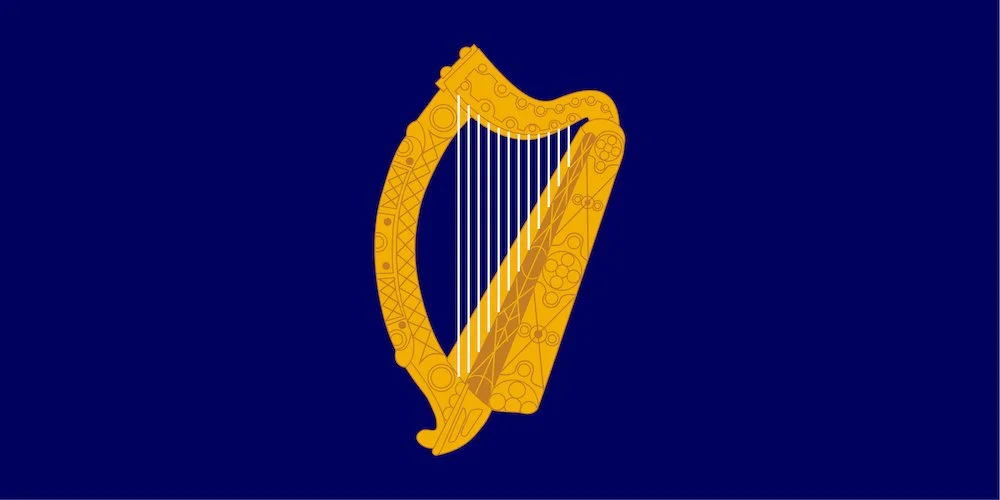
The symbol of Ireland
As ancient traders and travellers took the harp with them on their journeys, it was often adapted by the people they visited, who used different materials, had different musical tastes, and often hybridised the harp with more familiar existing instruments. So while there are records of harps of one kind or another in Ireland from about the 6th century (and it appears on 8th-century manuscripts, shrines, and high stone crosses) the “Irish harp” itself goes back about 1,000 years (Brian Boru was famously said to have a gift for it).
It was always seen as a prestigious instrument, only played by the gifted, and only owned by the wealthy, so Ireland’s old kings and chieftains always had one (and a harpist) to hand. It looked good; it made them look good; it accompanied a huge repository of Irish history in poems and songs. The Welsh cleric Cambrensis (or Gerald of Wales), who came with the English Prince John on a visit to 12th-century Ireland , felt that Irish harp music was the sole redeeming feature of an otherwise savage nation.
So, since it represented sophistication, wealth, music, and Ireland, the music-loving King Henry VIII was inevitably smitten with it. In fact he liked it so much that he was the first person to use it as a symbol of Ireland, stamping it on Irish coins minted from 1534 (he proclaimed the new Kingdom Of Ireland in 1541, formally making the harp the symbol). Then, in 1583 his daughter Queen Elizabeth I began to use the gold harp on a blue background as a banner, even issuing a charter in that form to Dublin. (In 1603 King James I incorporated the harp-on-blue into the British coat of arms, where you can see it to this day.)
As English rule tightened its grip on Ireland throughout the 16th and 17th centuries, the harp and those who played it became targets. Banned in the 16th century by Queen Elizabeth I, there were orders for harpists to be arrested and hanged for their association with "Irishness" and rebellion. Matters were not helped by Oliver Cromwell's subsequent attempt to destroy all harps in Ireland between 1650 and 1660. But, perhaps because of this, the harp on a green background (a deliberate act of reclamation) was first used in 1641 when Eoghan Rua O Neill returned from Spain to fight in the Ulster rebellion.
The great Gaelic order that had sustained harping culture was under attack, but did not quite die. Most notably, a harper named Turlough O'Carolan (1670 to 1738), was one of the last of the era to compose new music for the harp. Most of his compositions were not written down in his lifetime, surviving instead in the repertoire of other musicians. But they survived so well that O'Carolan is now regarded by many as Ireland's national composer, a blind itinerant who kept the form alive.
Gradually, in varying forms, and through various groups, the harp came to be associated with Irish resistance. During the 1798 Rebellion, Wolfe Tone and the United Irishmen placed a yellow harp on a green background and adopted the motto: "It is new strung and shall be heard." It was becoming the emblem of a republic not yet born, and finally becoming (in its gold-and-blue form) the official coat of arms of Ireland in 1922.
In 1923, Percy Metcalfe's harp design became the Great Seal of the Irish Free State, issuing on coins by 1928. His model was the instrument on display at Trinity College Dublin, long known as Brian Boru's Harp. (Actually it has nothing to do with Brian Boru, dating from the 14th or 15th century, but it certainly looks good).
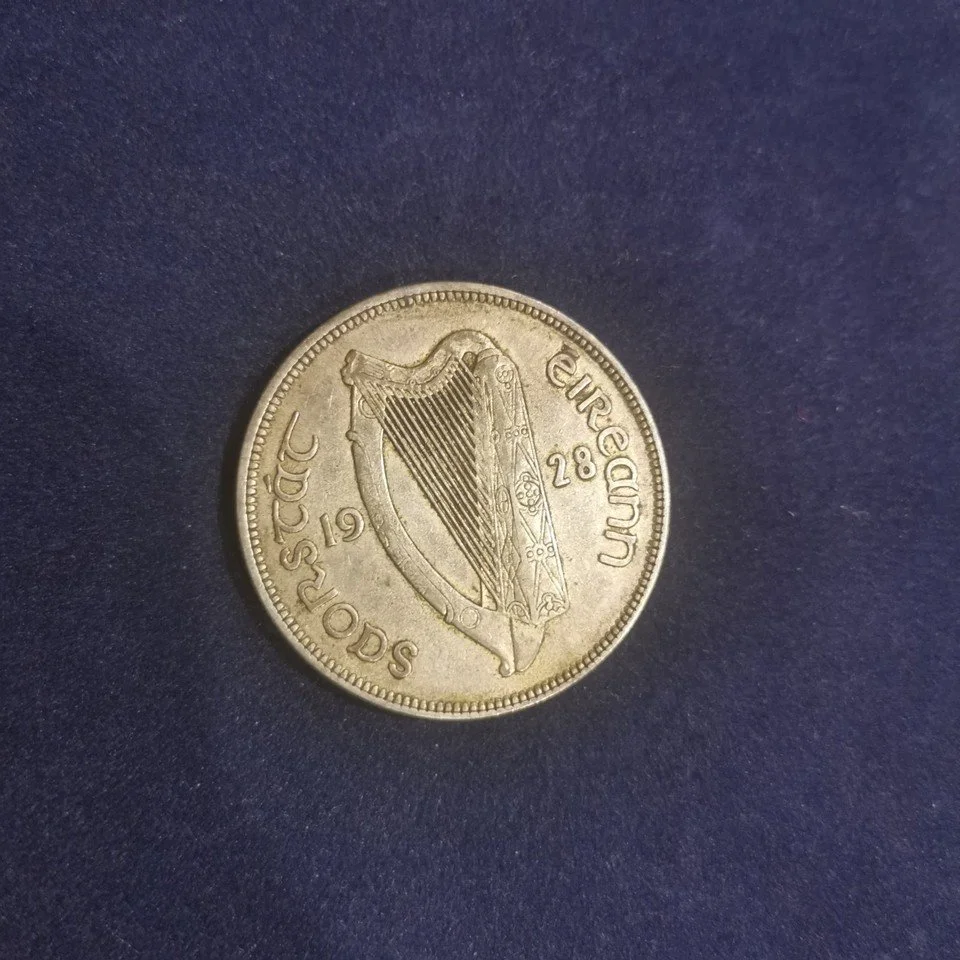
The official harp on coins in 1928
Footnote 1:
When the Irish state registered the harp as a national trademark in 1945, the Attorney General advised that it could only obtain rights to the left-facing harp, as Guinness had been trading under its right-facing version since 1862. The nation and the brewery most widely associated with it have faced in opposite directions ever since.
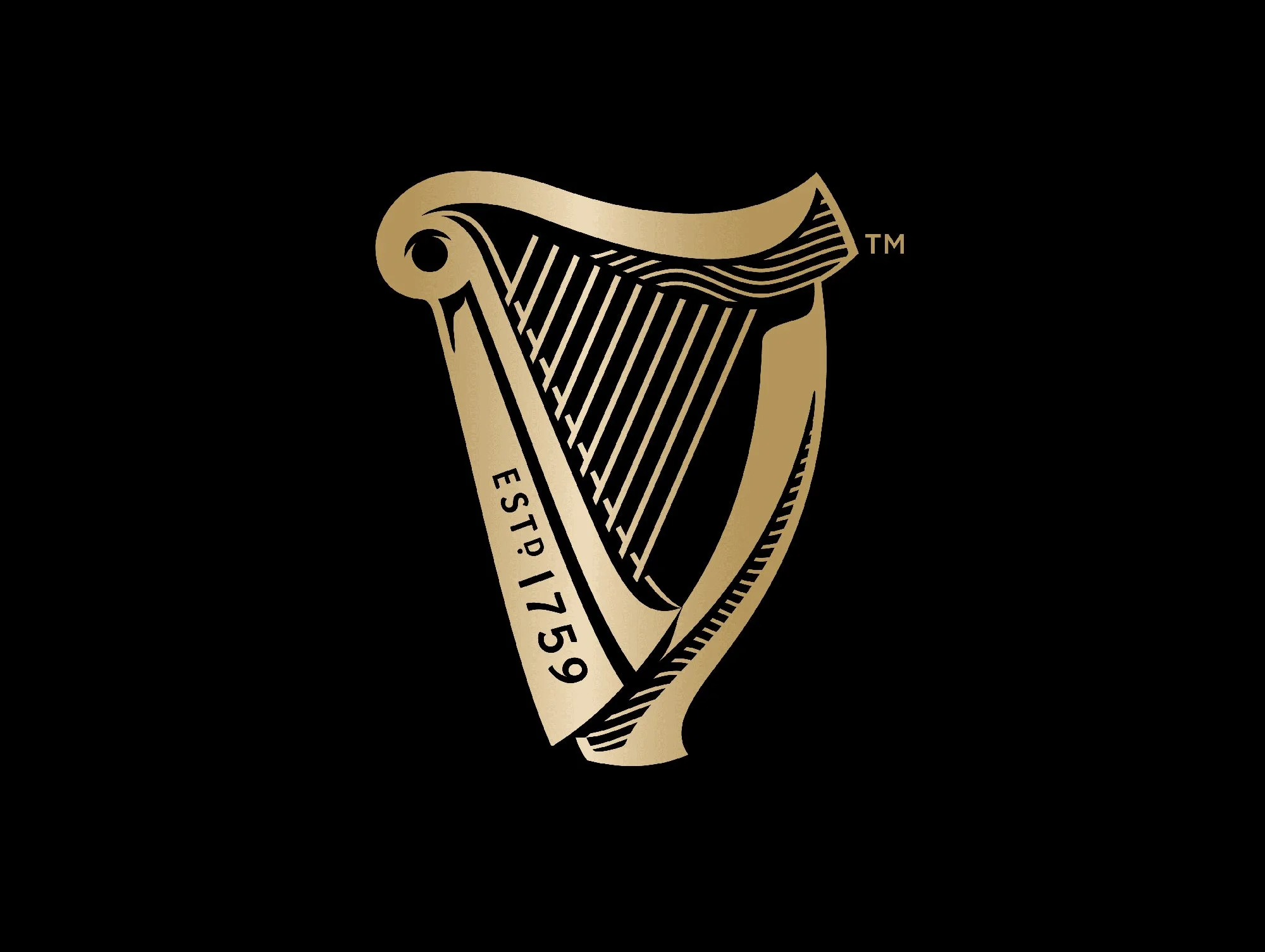
The other-way-around Guinness harp
Footnote 2:
The medieval name for the harp at the time was Cruit. There’s an island in Donegal called Cruit. There appears to be a link, but it’s not direct. The word originally referred to humps or little hillocks in the landscape, but came to be applied to a number of things with similar curved shapes. It’s likely that Cruit Island was named for its topography (a hump of land rising from the water), and the harp was named for its own similar curved shape.
(The word Cláirseach came later and referred specifically to the larger, wire-strung harp that became the distinctively Irish instrument — the one Gerald of Wales was raving about in, and that features on the coinage and the state seal.)
