
Workplace Stress: Society’s Terminal Illness?
For decades – for as long as I’ve been alive at least – busyness has been sold to us as a kind of virtue: the longer the hours, the more tired you were, the more noble your work was. And in itself it’s not all bad: there is value in work, and a certain level of busyness actually makes it easier than not being busy enough. But traditionally, for most workers at most times, there’s been a natural limit on busyness; and, conversely, there were fewer limits on your ability to actually do the work.
But here we are now, in 2026, and it genuinely looks as if either the whole concept of work and the workplace is going to collapse, or the workforce will. Because the ever-increasing stress is killing us. We are no longer just seeing isolated patches of it either: the growing weight of bureaucracy, digital overwhelm, social hostility (to name just a few of the newer issues) is making the workforce tired and even genuinely unwell. I believe we’re already at crisis point, and for all the talk of “wellness in the workplace”, there seems scant chance of it changing before the damage becomes irreversible.
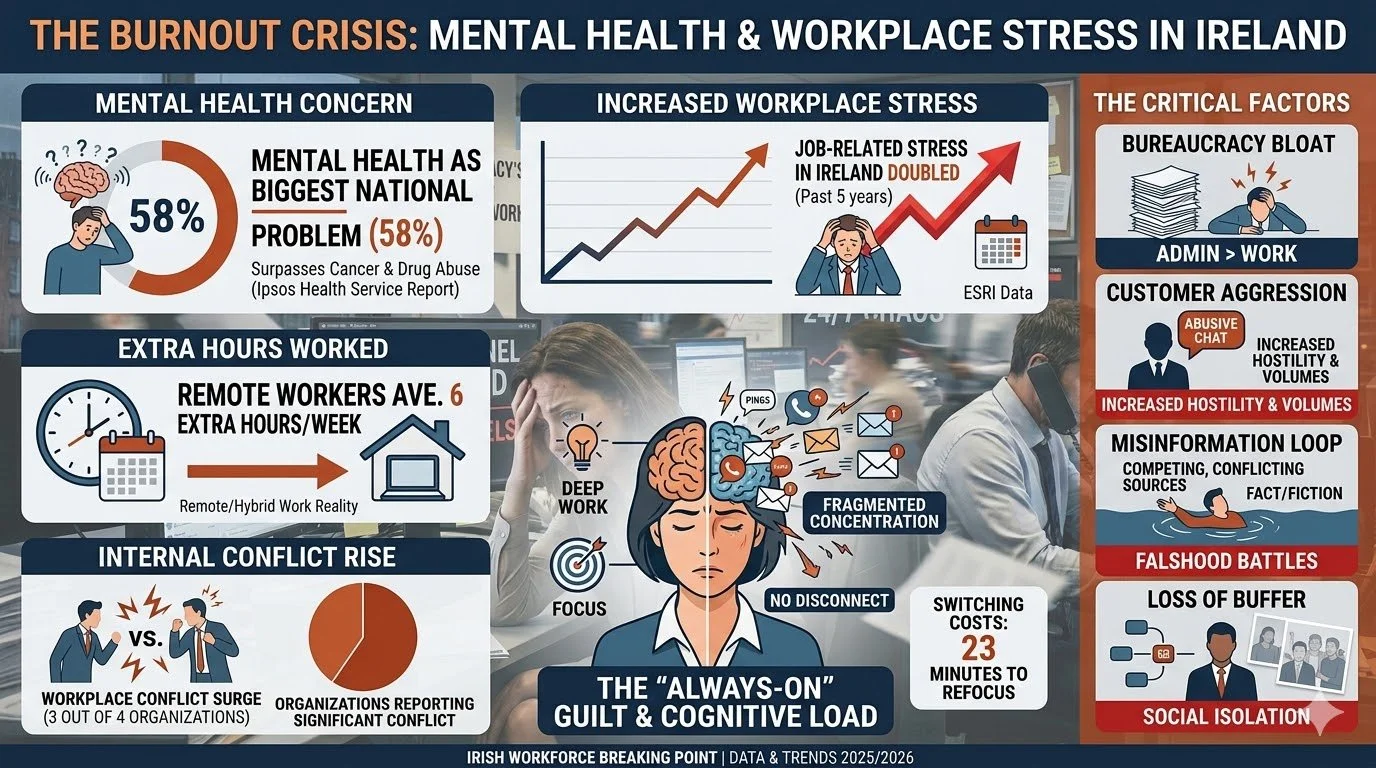
The figures from Ireland (and Ireland is not alone) should be enough to make us all stop and think. Approximately 18% of Irish workers are affected by occupational stress annually, one of the highest rates in Europe. In healthcare, the situation is at the point of emergency. 80% of doctors report experiencing stress, and a third suffer from clinical burnout — levels that exceed international norms. A January 2026 study for the trade union Fórsa found that 75% of social care workers regularly think about leaving their job, while almost half say they often or always feel burnt out, and 68% report illness linked to work-related stress.
The Economic and Social Research Institute has reported that 18% of all work-related illnesses in Ireland are attributable to stress, anxiety, and depression. Poor mental health costs Irish employers up to €2,000 per employee annually – and of course it’s only when it’s boiled down into numbers that a problem often just dismissed as a personal failing will be taken seriously.
The pattern broadly holds across professions too. A review of Irish mental health services found burnout rates of 31% to 65% (though the highest levels were recorded during and after the pandemic). Contributing factors named included excessive workloads, inadequate staffing, and structural inefficiencies. The conclusion of that research was clear: burnout in Ireland is not a blip (though Covid did contribute), but a persistent, system-wide condition.
Ireland, as I mentioned earlier, is not alone. Gallup's State of the Global Workplace 2026 report found that 66% of employees worldwide reported feeling burned out in the past year; among Gen Z workers, 58% report feeling emotionally detached from work due to stress, and 68% of Gen Z and 73% of millennials say they are considering leaving their jobs because of burnout (this is not to focus on a particular age group per se, but these people are just starting out and are already struggling). Globally, 40% of workers report significant daily stress. Global employee engagement (by which Gallup means the degree of commitment a worker has to their job/team/employer) fell to 20% in 2025. It’s all apparently costing the world economy $10 trillion in lost productivity (about the same as the combined GDP of Germany, Japan, and India).
What’s going on? What’s causing this – or at least, what are the newer factors that have led to such an increase in stress (not counting the sheer background stress of simply being in the 2026 world)? There are a few main reasons.
Bureacracy
One of the most frustrating features of modern work is how little of it involves the thing you’re actually supposed to be doing. The digital revolution was supposed to reduce paperwork, but it seems to have multiplied it, just in digital form: all those computer dashboards, compliance tickboxes, HR portals, and stats reports take hours that could be, but are not, spent on the actual work. And this bureaucratic bloat inflicts what psychologists call moral injury: the stress of knowing what you should be doing (and were employed to do), but being prevented from doing it because “the job” is in the way of “the work”. Sustained for years, that alone is a burnout risk.
Customer Hostility
The change in customer attitudes and expectations hits people doing public-facing work. The sheer volume of customer interactions has expanded hugely, driven by a proliferation of digital platforms (on top of the old phone/email/counter methods…which, yes, are still there too) and the expectation of instantaneous service. I can tell you that I left my own employment largely for this reason: for the last five years I worked there, I almost never got to the end of a thought or a sentence without being interrupted, and your thought process becomes a tatty and malfunctioning thing when that is sustained.
But as well as the numbers growing, the interactions have changed; since the pandemic, there has been a measurable increase in customer hostility. Frontline workers across Ireland and across jobs report that verbal abuse has become a routine feature of their day. That’s bad enough when it happens, but when every customer encounter could become another confrontation, the nervous system cannot settle, and your stress hormones don’t stop. It’s unpleasant, and over time it has been linked to cardiovascular disease, suppressed immune function, and chronic fatigue.
Social Media
With all the (justified) focus on the impact social media has on young people, its impact on workplaces is perhaps less visible – but it’s vast, and it’s poisonous. Platforms built around algorithms that chase numbers through outrage have trained millions of people to approach any kind of disagreement or unpopular decision as a reason for combat or angry campaigning. Employees must manage angry, entitled, unlistening customers coming at them with misinformation gleaned from viral content; gossipy websites publish headlines like “millions of customers to be affected” for routine changes (for a social welfare payment to avoid a bank holiday, for example) and as a result phone/Email/WhatsApp/SMS/Live Web Chat/X/DMs/Facebook services are overwhelmed with people furious about absolutely nothing; pharmacists field questions about unproven cures; public servants try to reason with people who have been radicalised against all institutions. And the thing is, it doesn’t stop: you go through that massively stressful debate, and finally put the phone down…and another call comes through from another customer angry about exactly the same thing. It’s utterly demoralising – and all of it is between you and the thing you’re supposed to be doing.
Family-friendly Problems
Remote and flexible work policies, designed to reduce stress, have in some ways made things worse. On any given day, that might mean there are fewer people to do something that can only be done in the office, or that “the person who knows everything” is not there to ask (and when you contact them at home for the info, only you get the answer – whereas, with an in-office conversation, everyone can benefit).
But weirdly, presumably because these are still early days and our approach is not yet perfect, even for people working at home it can cause problems. It’s erased the boundary between home and work. For over half of Irish workers in hybrid or remote roles, the home is now just a second office. Remote workers in Ireland were recently found to work an average of six extra hours per week, driven largely by guilt and the pressure to appear productive online, replying too quickly to emails in a kind of “I’m not watching the telly” way. Being at home also means you can be torn between work and domestic duties, and trying to answer an email while feeding a toddler is not only difficult but can make you feel you’re failing at both.
And none of this even mentions the things retirees fear to lose: those casual chats and shared sarcasm that make up a kind of social life. In fact I believe this will, in the long run, not just affect the atmosphere within the workplace, but will blend with our wider, work-generated burnout, cynicism, and apathy, to start wearing away whatever understanding or glue keeps our society together(ish). And that’s perhaps an even bigger issue than the workplace problems I started with.
The Responses
The most dishonest but most common response to this is to treat it as an individual problem. HR, doing its “we care” lip-service, sends us to bland mindfulness courses or recommends a shiny new app. And of course there’s all that guff about “resilience” – not just more deadening office jargon (something which is, I sincerely believe, yet another reason for disconnecting from the workplace), but another way of saying, actually, this is your problem, nothing to do with the nature of your work or your workplace.
Even without formal studies, if you’ve worked for a large employer, you can already see some of the results of all this: people are leaving, taking their knowledge and experience with them, even though at heart they still want to be nurses, teachers, social workers, whatever. The working conditions of our vocations in the 2020s are just making us too ill; the workplace, which is supposed to make life possible, is killing us.
Solutions?
Given the way the always-on, interconnected, overbusy world is nowadays, I can’t imagine any complete fixes. But the approach needs to move on from some HR staff (themselves disconnected) routinely sending out useless “wellness” emails. Some kind of structural reform is needed. That will involve individual employers reducing some of the ludicrous administrative burdens that take more time analysing potential efficiency than it would to just do the job. More broadly, while the right to disconnect is now a code of practice, the principle needs to be strengthened; the boundary between work and home should be made legally meaningful rather than aspirational; the 2026 Work-Life Balance Bill at least shows that there is some legislative work being done to move in this direction.
Even more fundamentally, though, we must realise that the grifting, grinding model we have been working under, in which human beings are just flesh-based productivity units, is unkind and wrong. If we must couch it in financial terms for employers to understand, a burned-out workforce produces less, costs more, and eventually stops showing up altogether. We’re at that point now. It should not be like this.
