
Top Ten Things We Think We Know About St Patrick

St. Patrick Was Irish
No, not even Irish. Patrick was born around 390 CE somewhere in what is now Britain to a Christian deacon called Calpurnius and his wife. According to the traditional narrative, at 16 he was enslaved by Irish raiders who took him to Ireland and held him captive there for six years, looking after animals. After his escape, he became a cleric before returning to Ireland. In later life he became a bishop - it’s not known where exactly he served, but he is venerated as a Saint in both the Catholic Church and the Eastern Orthodox Church, where he is regarded as equal-to-the-apostles and Enlightener of Ireland.
St. Patrick Was British
He wasn’t really British either, despite being born on the island. During his lifetime Britain was Roman, as was his own family. His parents are thought to have been part of the Roman aristocracy, and in fact Patrick signed his name in Latin as “Patricius,” which was traditionally not a person’s name but a word for the Roman upper classes (we still use the word “patrician” today to mean noble or aristocratic).
St Patrick’s Name Was, Er, Patrick
No, he adopted that - well, Patricius - in adulthood. But he was probably born Maewyn Succat.
St Patrick Used The Shamrock To Explain The Holy Trinity
It’s almost certainly untrue: two separate “triple goddesses” had long been worshipped in pagan Ireland, so the idea was hardly new to the locals. And there is no written reference to St Patrick using the shamrock until 1726, when the botanist Caleb Threlkeld wrote: “This plant is worn by the people in their hats upon the 17th of March, which is called St. Patrick’s Day. It being a current tradition, that by this Three Leafed Grass, he set forth to them the Mystery of the Holy Trinity. However that be, when they wet their Seamar-oge, they often commit excess in liquor, which is not a right keeping of a day to the Lord; error generally leading to debauchery.” Even if he did use the shamrock he’s likely still getting too much credit for it. Shamrocks had already been used for centuries in different places to represent triple concepts. They were already important in pagan Ireland, with the green colour representing rebirth. “Triple deities” were also already widespread in many ancient religions, and there’s even one theory that the word “shamrock” is derived from an ancient Arabian word “shamrakh” which means “three gods in one leaf.”
St. Patrick Brought Christianity To Ireland
Apparently not. He traditionally arrived here in 432 CE, but by 431, Pope Celestine had already sent Bishop Palladius “to the Irish believing in Christ”— which implies that, even before Palladius arrived, there was already a Christian community here. (It’s possible that the story of St Patrick as we know it is actually an amalgamation of the lives of Patrick and Palladius.)
St Patrick Chased The Snakes From Ireland
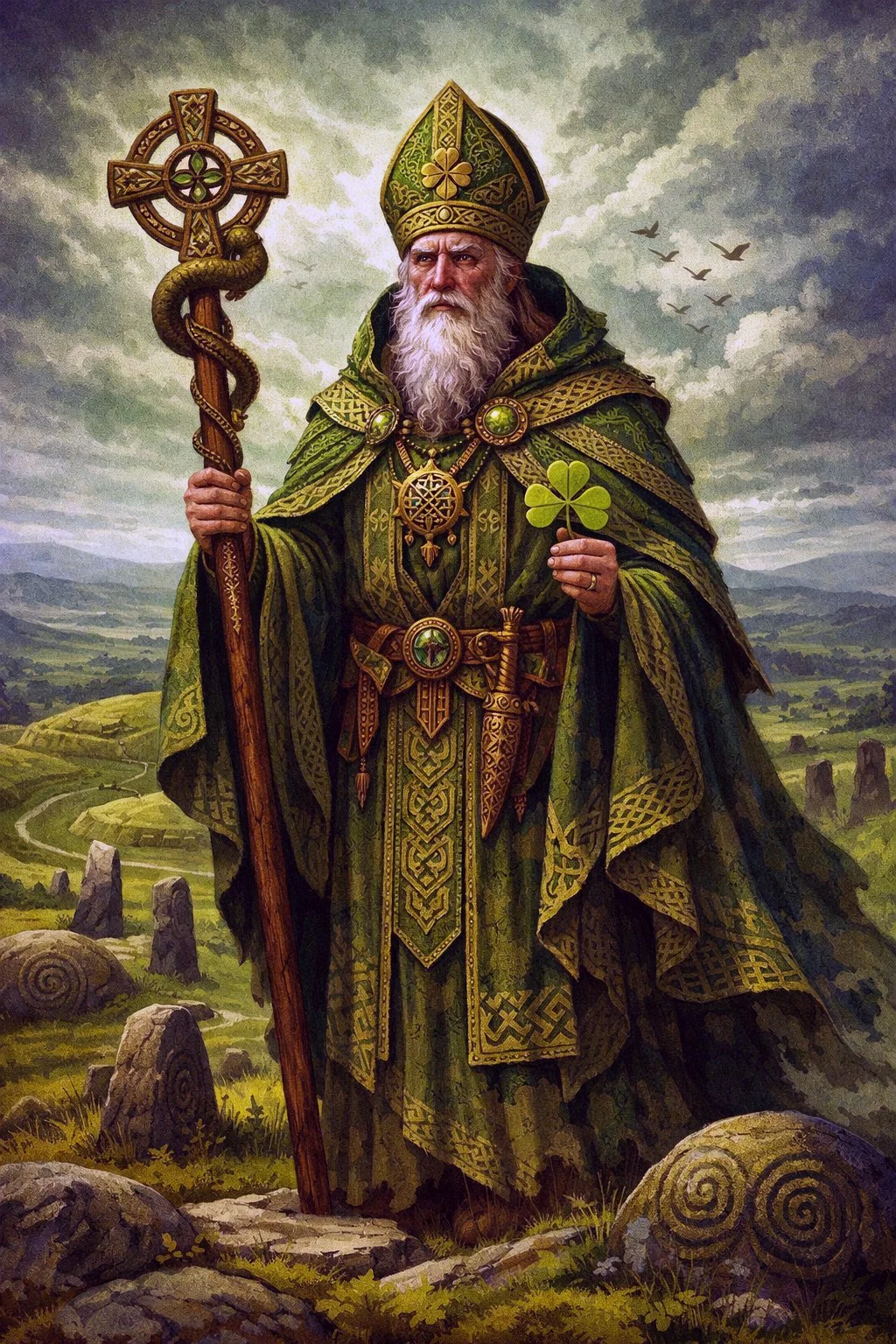
No. It’s a cinematic image: a man in robes standing on an Irish hill, passionately preaching a sermon that has such an effect. It’s just not true: there were no snakes in Ireland at that time. Snakes were widespread in pagan religions, though, and they’re used here as a symbol of paganism. In fact the last Ice Age (30,000 BCE to 8,000 BCE) drove the snakes out of the country; and since it ended, we’ve been surrounded by water so snakes just can’t get back here. Anyway, given what we know now about ecosystems and nature’s interdependence, and the fact that snakes are just creatures (not demons), such an act would be an ecological disaster.
St Patrick’s Colour Was Green
No, it was blue - specifically a colour named St Patrick’s Blue. Green was used in the 18th century by various supporters of Irish independence - but it was the colour for Ireland and “the cause”, not for St Patrick. But when - also in the 18th century - Irish immigrants in the United States began organising Irish parades on March 17, green also slowly became associated with St Patrick himself.
St Patrick Has His Own Flag
Yes he does: it’s the St Patrick’s Saltire (right), a diagonal red cross on a white background. You’d be hard-pressed to see that in modern Ireland, though, where it’s the country’s tricolour we see most often on March 17th (something which has annoyed Unionists in Northern Ireland, who reject the link between the tricolour and St Patrick). Perhaps surprisingly, the place you’re most likely to see the Saltire these days is in the Union Jack. When Britain and Ireland merged under the 1800 Act of Union, it was incorporated into the UK flag, where you can still see it (alongside the white diagonals of St Andrew’s flag).
St Patrick’s Day Parades Are An Irish Thing
Not really - they certainly didn’t originate here. The first recorded parade took place in 1737 in Boston, when 27 Irish immigrants got together to celebrate their heritage. We can probably imagine how that went. The first “official” St. Patrick’s Day Parade happened in New York in 1762. Only in 1903 did the day become a holiday in Ireland.
St Patrick’s Day Has Always Been A Party In Ireland
No. Until the US parades began to influence us, it was mostly a solemn and prayerful day. Even up to the 1970s, pubs could not open here on March 17 (it was feared that open pubs would be too tempting during Lent). Mind you, you could still get a drink on the day if you went to The Royal Dublin Dog Show; this was the only place to get a pint, and unsurprisingly proved hugely popular, and not just with dog lovers.
