
The Origins Of Mother’s Day
Some holidays, let’s be honest, feel like something Big Card has invented just to sell more cards. And for a long time I suspected this is where Mother’s Day came from – there are perfectly good reasons to celebrate mothers, but that’s often exactly what the card companies count on when they want us to buy something.
But the deepest roots of Mother’s Day are older than you might think. Much older. The idea of honouring a mother figure is older than Christianity itself. The ancient Greeks presented offerings of flowers and food to Rhea, mother of the gods, while Romans dedicated a temple to their equivalent, Cybele, celebrating her in the spring Festival of Hilaria with gifts and a bit of ceremony. These early observances marked the fundamental renewal of life, whether through the earth itself at that time of year, or to the women who sustained it. (“Hilaria”, by the way, is Latin for "the cheerful ones," an unusually happy and harmless reason for a celebration in ancient Rome. Yes, it’s related to “hilarity”.)
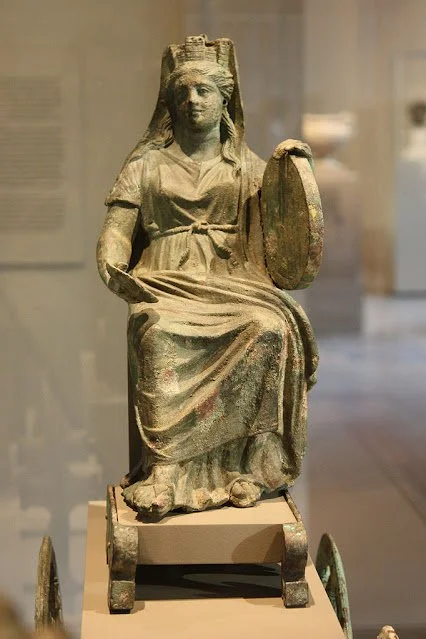
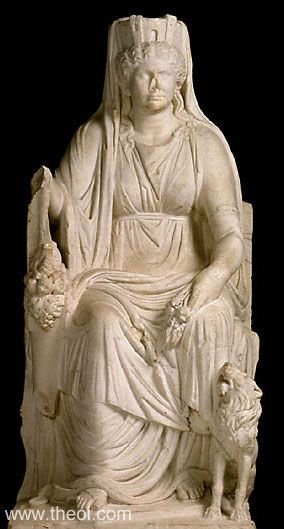
Photos: left, Cybele with a tympanum, her favourite instrument; right, Rhea, one of the Titans
As Christianity spread through Europe, those older instincts were repurposed rather than abandoned. That allowed, for example, a greater focus on the Virgin Mary as the mother of Jesus. And by the Middle Ages, a tradition known as Mothering Sunday had emerged in Britain and Ireland, which was rooted less in family but in religious duty. On the fourth Sunday of Lent (seen as a day of respite halfway through the season) people would return to their "mother church," the place where they had been baptised. Inspired by the psalm "We will go into the house of the Lord," medieval congregations made pilgrimages to these great churches, and the day's liturgy was full of maternal language and metaphor.
In Ireland, this religious obligation quietly became something else. During the 18th and 19th centuries, young rural people routinely went into service as domestic workers or apprentices in large houses. They didn’t leave the houses much, and Mothering Sunday became the one day of the year when they were allowed to go home. For some people unhappy in their new roles, it was the most anticipated day of the year (the phrase "going a-mothering" was recorded in 1644). The day’s traditions at that that time included children picking wildflowers to give to their mothers, and the family eating Simnel cake, a rich cake with almond paste baked for the occasion (the Church relaxed its Lenten fasting rules for the day, allowing families to eat properly together).
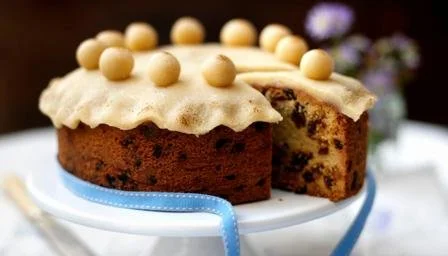
Simnel Cake. Usually decorated with 11 balls to represent the Apostles minus Judas.
It was common, but it was perhaps more regional than really widespread. In the 1825 The Guide to the Year, the English author William Hone (1780-1842) noted that “It is still a custom on Mid-Lent Sunday in many parts of England, for servants and apprentices to carry cakes or some nice eatables or trinkets, as presents to their parents...and in other parts, to visit their mother…to receive cakes from her with her blessing. This is called going a mothering.”
By the late 18th century, the practice had largely died out in Ireland. But, like a lot of occasions once popular in these parts, it was revitalised in America – unusually, almost entirely by an individual instead of a social mood. Anna Maria Jarvis’ mother, Ann Reeves Jarvis, had been a peace activist who had long used the day to hold "Mothers' Day Work Clubs" to raise public health issues and "Mothers' Friendship Days" to help reconcile Union and Confederate soldiers after the Civil War (she had lost four of her own children in the war). When Ann died in 1905, her daughter Anna wanted to honour her and the sacrifices all mothers make for their children.
In May 1908, Anna organised the first official Mother's Day events at a Methodist church in West Virginia, and at a department store in Philadelphia. At that first service, she effectively made the carnation the official Mother’s Day flower by distributing 500 to the congregation. Her choice was smart: not only was it her mother’s favourite flower, symbolising purity and endurance, but its petals fold inwards as they die, which reminded Anna of a mother drawing her children to her heart. (By chance, there was also a suitable old Christian legend that pink carnations first bloomed where the Virgin Mary's tears fell as she watched Christ carry the cross). Over time this evolved into a colour-coded tradition: white carnations for mothers who had passed away, red or pink for those still living.
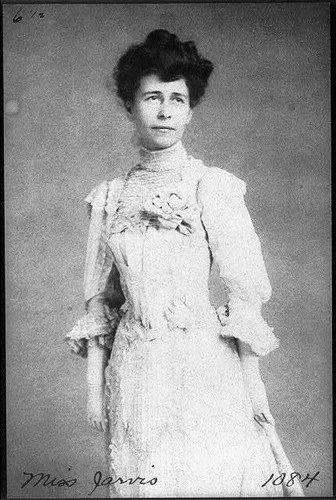
Anna Jarvis
By 1914 Anna’s campaigning had persuaded President Woodrow Wilson to make the day an official one across the USA; he signed a proclamation designating the second Sunday in May as Mother's Day (chosen by Anna as her mother had died on the second Sunday).
But almost immediately, the holiday was captured by the commerce that has shaped most of our festivals ever since: flowers, printed cards, boxed chocolates and gifts flooded the market. Anna was appalled. She denounced the industries profiting from the holiday, calling them "charlatans, bandits, pirates, racketeers, kidnappers and other termites," and spent the rest of her life and fortune trying to have the holiday abolished. In 1930, she was even arrested for disturbing the peace at a gathering of soldiers' mothers selling carnations; one of the very last things she did before entering the sanatorium she would die in was to go door-to-door in Philadelphia asking for signatures to back an appeal for Mother's Day to be abolished. Anna died of heart failure in 1948, having disowned the celebration she created. (Though some of her medical bills were reportedly paid by the florists she had fought for years.)
Over here, Anna’s campaign inspired a Constance Penswick-Smith to found the Mothering Sunday Movement in the UK in the early 1920s, calling for the revival of the older tradition. That didn’t change things immediately, but it did leave the public receptive to the idea; so, when American and Canadian soldiers stationed in Britain during World War II brought their own holiday customs with them, the two traditions merged, and Mothering Sunday was reborn.
Still, Ireland kept its own calendar. The date here is still tied to the liturgical year: it falls on the fourth Sunday of Lent, so it shifts with Easter, rather than being the fixed second Sunday in May observed in the US.
As a final note for all the sticklers, it is indeed Mother’s Day, not Mothers Day - the apostrophe, dear old abused mark that it is, is there to emphasise the celebration of each individual mother, not just the great mass of mothers together. And if you don’t believe me, look to Anna Jarvis herself, who claimed copyright on the phrase "Second Sunday in May, Mother's Day", and aggressively sued many companies who used the plural spelling Mothers Day just to get around her copyright claims.
