
Staff Issues
It’s becoming more common these days to see medicine symbolised by a winged staff with two snakes coiled around it; it’s even on the counter of some doctors’ clinics in Ireland. You would almost think it really did have some link to medicine - but, other than looking a bit like the real symbol (a simple staff with one snake), it doesn’t at all. We’re just using it in the wrong way.
The actual ancient symbol for medicine is called the Rod of Asclepius: it’s the single staff and single snake we grew up seeing, and we still see on some pharmacies (although more pharmacies these days are using the Greek cross). It’s named for Asclepius, the Greek god of healing, and it’s designed after an incident in the Bible, in which God, having sent “fiery serpents” to attack the Israelites who had spoken against him, then told Moses to protect them against the venom by erecting a bronze serpent on a pole. Going even further back, snakes were already associated with healing because their venom worked against some ailments, and because they could go quickly from being inert (even apparently dead) to perfectly active.
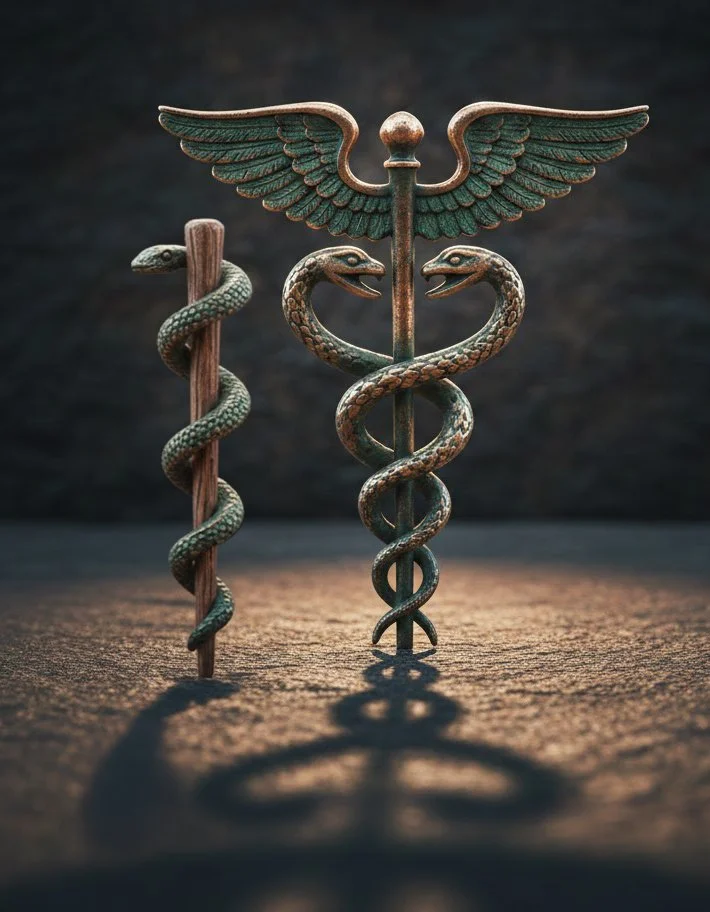
The Rod of Asclepius and the Caduceus
The other symbol - the wrong one with two snakes - is called the caduceus, and represents a moment in Greek mythology when the god Hermes (represented by the wings) threw his own staff at two snakes to stop them fighting. It’s actually the ancient symbol of merchants, messengers…and thieves and tricksters. Hardly appropriate for respectable medicine, you’d think. Why the confusion? In the 19th century, somebody designing American military uniforms got the two symbols mixed up, and its adoption in 1902 by the US Army Medical Corps helped spread the symbol across the world.
Mind you, while various US bodies (largely related to the military) still use the caduceus, most organisations still use the correct symbol: the World Health Organisation, for instance, features the rod of Asclepius correctly in its logo, and if we don’t take WHO’s word, then whose word? Because of its use by military medics, though, the caduceus has slowly become recognised in warzones, not as a symbol of medicine itself, but as a sign that the medics using it are non-combatants.
