
Is One Battle After Another Just Too Much?
There are always problems with hype and expectation, not just around widely-praised films, but their directors as well. The hyped film comes to us pre-loaded with viewer demands it can struggle to match; and the acclaimed director is perhaps less inclined to rein in their own excesses than the gifted-but-constructively-criticised one.
I’ve seldom seen both problems so prominent in a single film as in One Battle After Another, probably 2025’s most universally-praised release. To be clear, I’m not saying this is a bad film: it’s often very impressive. But it’s also arguably a textbook example of a film that is undeniably "good" while being immensely overrated, the exact thing that can lead to such feelings of underwhelm. On a technical level, it’s a marvel; the choreography is precise, and the scale is broad, and the acting superb
But step back a little: it’s not too hard because our emotions are rarely engaged here. Under the grit and the gloss, there’s a film that suffers from a fundamental lack of restraint in its pacing, in its shifts in tone, and a score that refuses to let the audience breathe. To some extent, that’s all advertised by the on-the-nose title: it really is just a relentless series of high-kinetic scenes that rarely takes (or allows us to take) a breath. It’s something most films and filmmakers understand – that exciting scenes work best when there’s some respite, when they have something to stand out from – but sadly not here. Here it’s often exhausting.
I have to say too that I genuinely struggled to get through the first half hour: all that chaotic noise, those volume surprises, the unfunny moments of surreal humour just act as barriers to our investment. The word “comedy” is used quite a lot in the film’s publicity, but most of the humour is too awkward or out-of-place to land; though Leonardo DiCaprio (“Life!”) is consistently amusing as he tries, one way or another, just to keep up.
It’s also – whisper it – not as “profound” as it’s supposed to be. It’s never quite clear what the rebels are fighting for, and because the film never breathes it never takes time to explore any of its interesting societal/familial themes in any depth. Teyana Taylor’s Perfidia, a crucial if controversial presence, is interestingly unclear in her personal motives, but she’s also just difficult to hear at times.
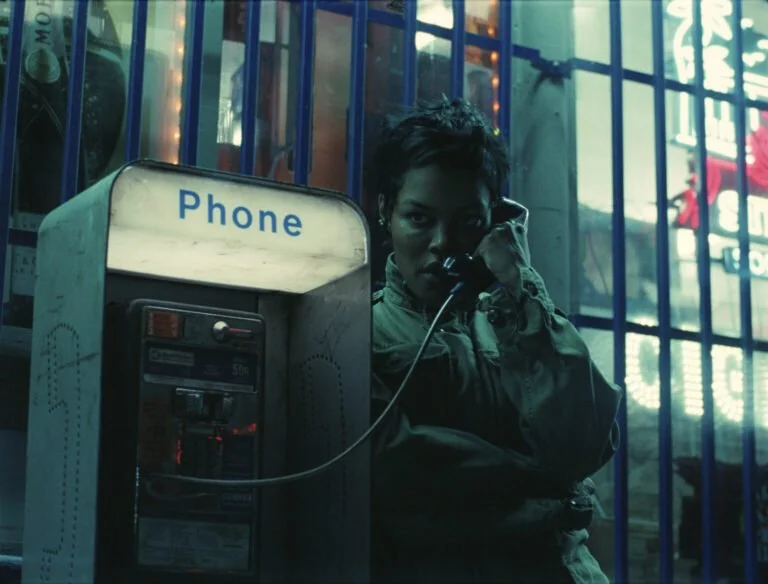
Teyana Taylor as Perfidia: unreadable, sometimes inaudible
Which subject – the sound mix – brings me to the film’s most significant flaw, and a sign that director Paul Thomas Anderson is simply being excessive. The soundtrack, by Jonny Greenwood, is an interesting one, all hammered notes and sustained strings, is full of drama…but oh, can we turn it down, please? For about two-thirds of the film it’s as loud as the dialogue, a blunt instrument abused by a child; it chisels its way in between you and whatever is happening on screen, which means you can’t really connect to the action or the characters.
When everything is heightened, nothing is, and subtlety is lost. It doesn’t support the story; it competes with it for the viewer’s attention. I’ve seen some defenses of the soundtrack arguing that PTA is making it deliberately stressful because he wants us to feel the same stress as the characters. But that’s not sympathy with or understanding of the film, that’s just annoyance: the same feeling you experience when someone is chatting on the phone in the row in front of you.
In the last third the film develops into a compelling three-way car chase. It’s not just tense, it’s filmed on dippy roads with low cameras so viscerally you’ll feel your stomach lift and sink with it. It’s great; it’s completely engaging; but it’s no coincidence that it’s also the first time the soundtrack is silenced and we can actually relate to the story.
