
The Glorious First?
The Glorious First?
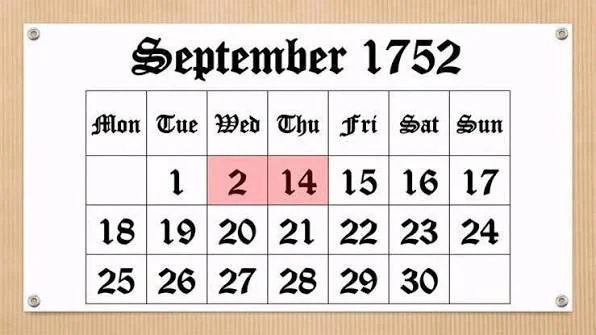
We probably don’t spend a lot of time thinking about September 1752. But it’s an interesting month. Look it up online (or open a Terminal on a Mac or Linux machine and type cal 9 1752), and you'll find a short month: it runs normally to Wednesday the 2nd, then jumps to Thursday the 14th. Eleven days just aren't there.
It's a well-known piece of software trivia (Unix has had it hard-coded since the very first edition in 1971, for example), and it’s not a mistake. It's a fossil of the Calendar (New Style) Act 1750, the British Parliament's fix for a Julian calendar that had drifted badly out of step with the sun and with the rest of Western Europe, which had switched to the Gregorian calendar back in 1582. The problem had been building up for over 1500 years, with the calendar drifting a little bit every year. The Julian calendar, introduced by Julius Caesar in 46 BCE, assumed a year was exactly 365.25 days long and accounted for it with a leap day every four years. But the actual length of a year is 365.2422 days, roughly 11 minutes shorter. That 11-minute overcorrection seems trivial, but it compounds to about one extra day every 128 years. By 1582, the Julian calendar had drifted 10 days ahead of the sun, pushing the spring equinox away from its traditional date and throwing off the calculation of Easter, which the Church tied to it. Pope Gregory XIII fixed this in 1582 with the Gregorian calendar: it dropped 10 days outright and refined the leap-year rule so that century years (like 1700, 1800, 1900) are only leap years if divisible by 400.
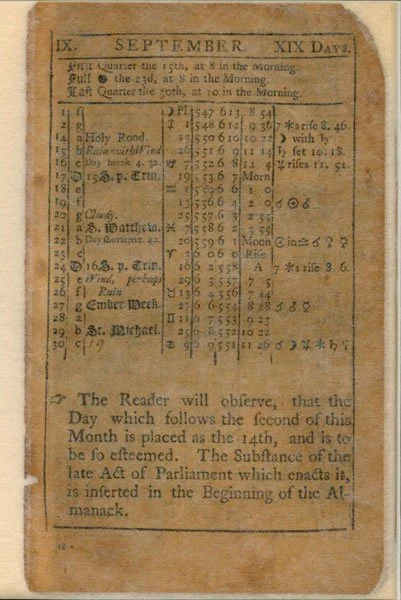
A page from William Hunter's Virginia Almanack
Britain didn't adopt it until 1752, by which point the gap had grown to 11 days. The 1752 Act worked in two stages. First, it moved New Year's Day from March 25th (yes, for centuries the year in England and other parts of Europe started on that date…which meant that 24/3/1711, for example, would be followed by 25/3/1712) to January 1st, which made 1751 a "short year" of just 282 days, running from 25 March to 31 December. Then, in September 1752, it deleted the accumulated 11-day error outright: Wednesday, September 2nd was legally followed by Thursday, September 14th. Millions of people went to bed on the 2nd and woke up on the 14th.
It’s fair to say it doesn’t come up very often. So why am I bringing it up now? Well, it’s the weekend of The Glorious Twelfth, in which Orangemen celebrate the victory of King William III at the Battle of the Boyne. And it turns out that battle was actually fought on 1 July 1690, under the old Julian ("Old Style") calendar Britain and Ireland were still using. When the 1752 Act came into force, the missing days bumped the anniversary to 11 July (not the 12th directly, because – sigh – in 1690 the calendar was only out by 10 days, and the extra 11th day only accumulated by 1752…)
That was right on the eve of 12 July — which had already been the established date for commemorating Aughrim, the same war's actual decisive battle of 1691. But Aughrim’s anniversary was now also bumped forward by the new calendar. So the two anniversaries collapsed into one around the old familiar date of the 12th. With the founding of the Orange Order in 1795, this is how "The Twelfth" came to be fixed: nominally the Boyne's anniversary, but actually set on what had originally been Aughrim's day.
Other Broken Dates
The 11-day jump rippled beyond Ireland, though. George Washington was born on 11 February 1731 under the Julian calendar. Because the Act also moved New Year's Day, after the 1752 correction his birthday shifted to 22 February 1732 — a jump of a year and eleven days combined. Washington himself accepted the new date, though some of his contemporaries kept marking the 11th out of habit; both dates were celebrated during his lifetime.
Christmas, of course, was also nudged forward from 25 December Old Style to 6 January New Style. That was the date of the Feast of the Epiphany, the traditional end of the Christmas season, but that’s just coincidence. Many communities simply refused to move Christmas Day itself, quietly continuing to celebrate "Old Christmas" on January 5th or 6th (sometimes called Old Christmas Eve and Old Christmas Day) for generations. Scots-Irish settlers carried the custom to Appalachia, where it survived in isolated mountain communities well into the 20th century, complete with its own folklore (that farm animals could speak at midnight, or that elder bushes bloomed on Old Christmas Eve). Ireland has its own tradition, "Little Christmas" or "Women's Christmas" on the same date. Some Appalachian and Amish communities keep some version of Old Christmas alive today.
The tax year was affected too. The Treasury pushed the traditional New Year date (25 March, remember) forward to 5 April. A further wrinkle in 1800 — a leap year under the old Julian rule but not the new Gregorian one — pushed it forward one more day, to 6 April, which is where the familiar start date of the tax year came from (changed in Ireland a few years ago, but still where the UK's tax year begins to this day).
The change wasn't universally welcomed. Protestant traditionalists distrusted a calendar associated with Rome, and fears spread that landlords would demand a full month's rent for a shortened month; there were some protests that lives were literally being cut short, that somehow people were literally 11 days older. In 1755, the satirist William Hogarth painted an image of mobs rioting in the streets chanting "Give us our eleven days"; though it’s not clear how widespread the “calendar riots” really were.
Note: Why the Boyne, When Aughrim Was the Real Turning Point?
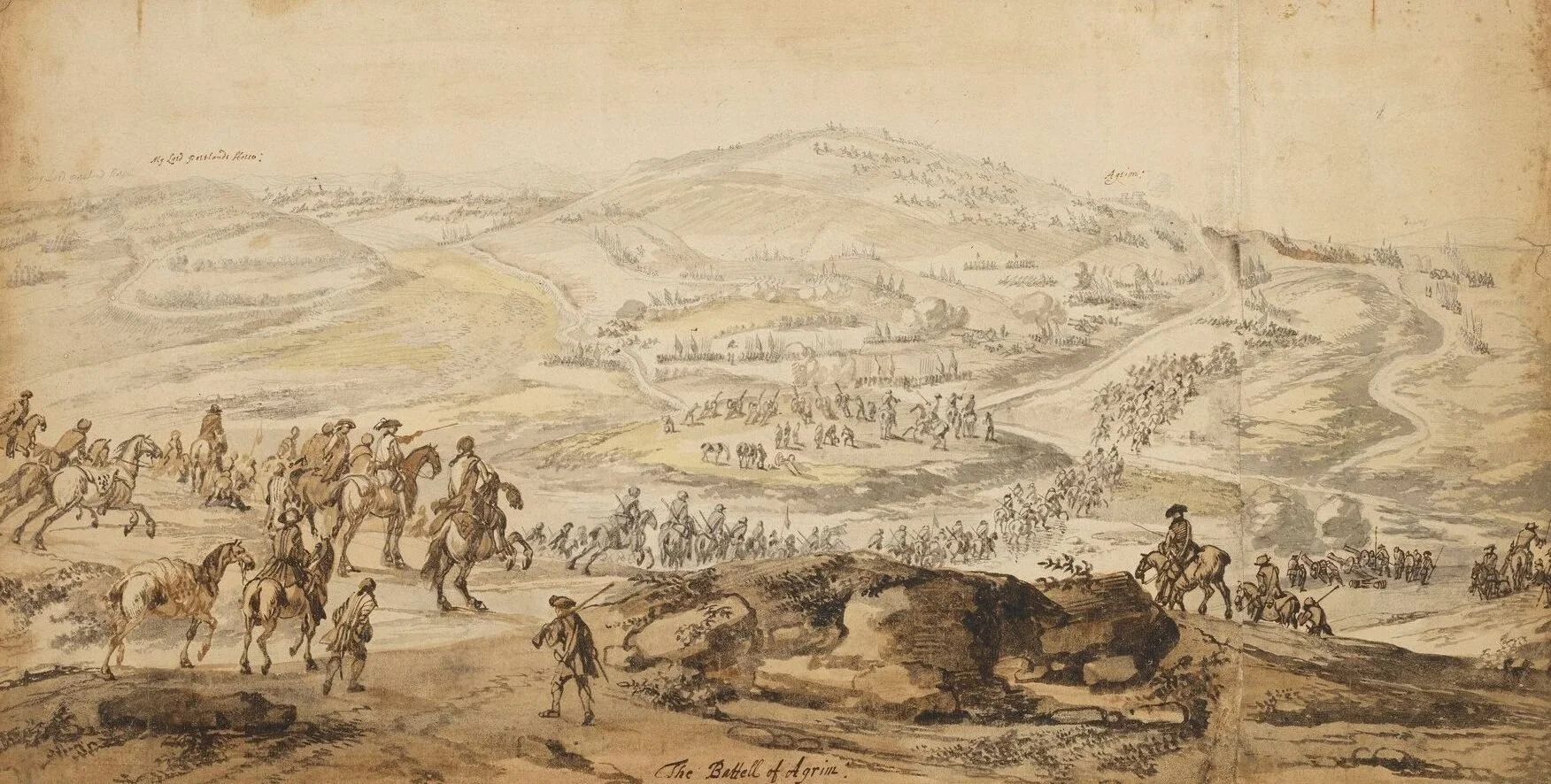
A view of the battle of Aughrim, by Jan van Wyk
For roughly a century after the war, it was Aughrim, not the Boyne, that was marked on 12 July. Aughrim was the war's actual climax, an encounter so bloody it's remembered as "Aughrim of the Slaughter." Total losses were as high as 7,000, several times the roughly 2,000 killed at the Boyne the year before.
But the Boyne had star power: both kings, King William III and the deposed King James II, were on the battlefield on the day (whereas Aughrim was fought by proxies). The Boyne's story was also tidier and less unpleasant than the carnage at Aughrim. The main push was institutional: when the Orange Order was founded in 1795, it was built explicitly around William of Orange, and it promoted the Boyne as its central legend: his battle, at which he was present, and a much more depictable one than Aughrim.
