
Men & Women: The Real Differences
We really do feel the world differently
Not talking about the big, obvious biological divides here: obviously men are unlikely to experience what it’s like to be pregnant, and women will never know what that zipper mishap is like. It’s far more interesting and useful to consider those experiences that, on the face of it, you’d expect to be the same, but which are actually processed differently by male and female brains (that is, in terms of population averages – individually there are lots of overlaps).
So here, in no special order, are 10 ways men and women experience the same world differently – often down to the old hunter-gatherer lifestyles (where men would hunt and women would gather) we once universally lived.
Colour v Motion
Women generally have a higher sensitivity to the nuances of colour, particularly in the middle of the visible spectrum (greens and yellows). I can personally attest to this, because I once worked in a shop where women would spend ages choosing among a dozen shades of cream that looked no different to me (or their flummoxed partners). Men, however, are often better at detecting fast-moving objects and tracking fine details at a distance. This is usually attributed to different concentrations of androgen receptors in the visual cortex. Women are also see simple brightness better – sometimes my wife reads her Kindle when I can barely tell that it’s on.
Why is this? Hunters needed to track fast-moving prey against a chaotic background, while gatherers needed to identify ripe (or overripe) fruits and herbs hidden in foliage.
Pain Perception and Threshold
Research suggests that women typically have a higher density of nerves in the skin and a more active immune response to injury. This often leads to women reporting higher levels of pain than men for similar stimuli. Interestingly, though, women also tend to deal better with that level of pain – so it takes a brain scan, rather than waiting for people to cry out, to detect actual pain levels.
Navigation
Both sexes are perfectly capable of getting from Point A to Point B, but often use different strategies. Women are more likely to rely on landmarks (you know, "Turn left at the bakery"), whereas men are more likely to use cardinal directions ("Go North for two miles") and a general sense of geometry.
In evolutionary terms, men rarely got to chase wild animals in a straight line, and had to constantly update their position relative to home and to the animal’s path (a process called path integration). Meanwhile, a gatherer (more likely to be female) often needed to return to a very specific locations (like a hidden fruit tree) – so remembering a specific rock formation or bend in the stream was a better method than just knowing it was "somewhere to the west."
Hearing Sensitivity
Women generally have more sensitive hearing, particularly in the higher frequency ranges (above 2 kHz). This makes women more attuned to subtle shifts in vocal tone or the sound of a crying infant, whereas men’s hearing is often more specialized for identifying the direction of a sound (a hunting advantage).
Peripheral v Tunnel Vision
Women have broader peripheral vision, allowing them to take in a wider panorama of their surroundings at once. Men tend to have better centralised, tunnel vision, which excels at focusing intensely on a specific target or objective.
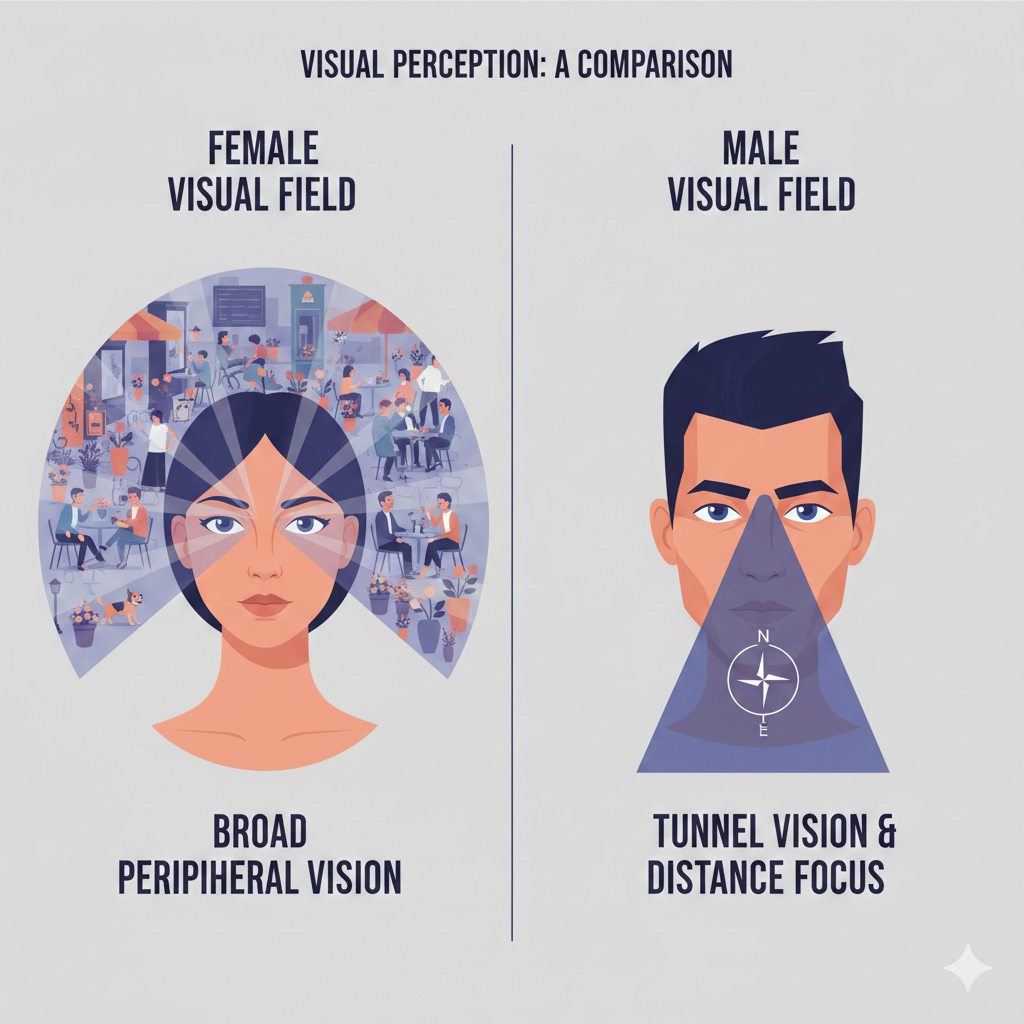
Men and women see things differently. Both, though, can spot an AI spelling.
The Social Battery
Under stress, the chemical responses differ slightly. Men lean toward the fight-or-flight response (driven by testosterone and cortisol) needed in dangerous hunts or war. Women are more likely to exhibit a "tend-and-befriend" response, driven by oxytocin, which prioritises social bonding and support to manage a threat (and prevent conflict within the social group). It’s likely that this is also behind the fact that women tend to be more sociable, whereas men often find just as much stimulation in their mancaves.
Temperature Regulation
The office thermostat war is real, and rooted in physiology. Women generally have a lower metabolic rate and a higher surface-area-to-volume ratio than men. Additionally, women’s bodies are more efficient at pulling heat toward the core to protect internal organs, which leaves their hands and feet feeling much colder than a man's in the same room. A famous study published in The Lancet found that a woman’s core temperature is about 0.4°F higher than a man's, but her hands are 2.8°F colder.
Because of this, the ideal room temperature varies significantly: about 21.5C for men, about 25C for women. Almost inevitably, a formula for the perfect office temperature was calculated in 1960s – based on a typical 154lb male standard.
Sense of Smell
Women consistently outperform men in identifying and discriminating between smells. Studies have shown that women have significantly more neurons and glia in their olfactory bulbs, making their experience of food, perfume, and environmental scents much more vivid than men’s.
Facial Expression Recognition
Women are generally faster and more accurate at decoding non-verbal cues and facial expressions. This leads to a world-view that is often more socially legible, where subtle shifts in a companion's mood are noticed immediately (whereas men may sometimes just need to be told verbally).
Risk Assessment
Neurobiologically, the amygdala and the prefrontal cortex interact differently across the sexes. Men are often more likely to perceive a risky situation as a challenge or thrill, while women are more likely to process that same situation through a lens of potential consequence and safety.
