
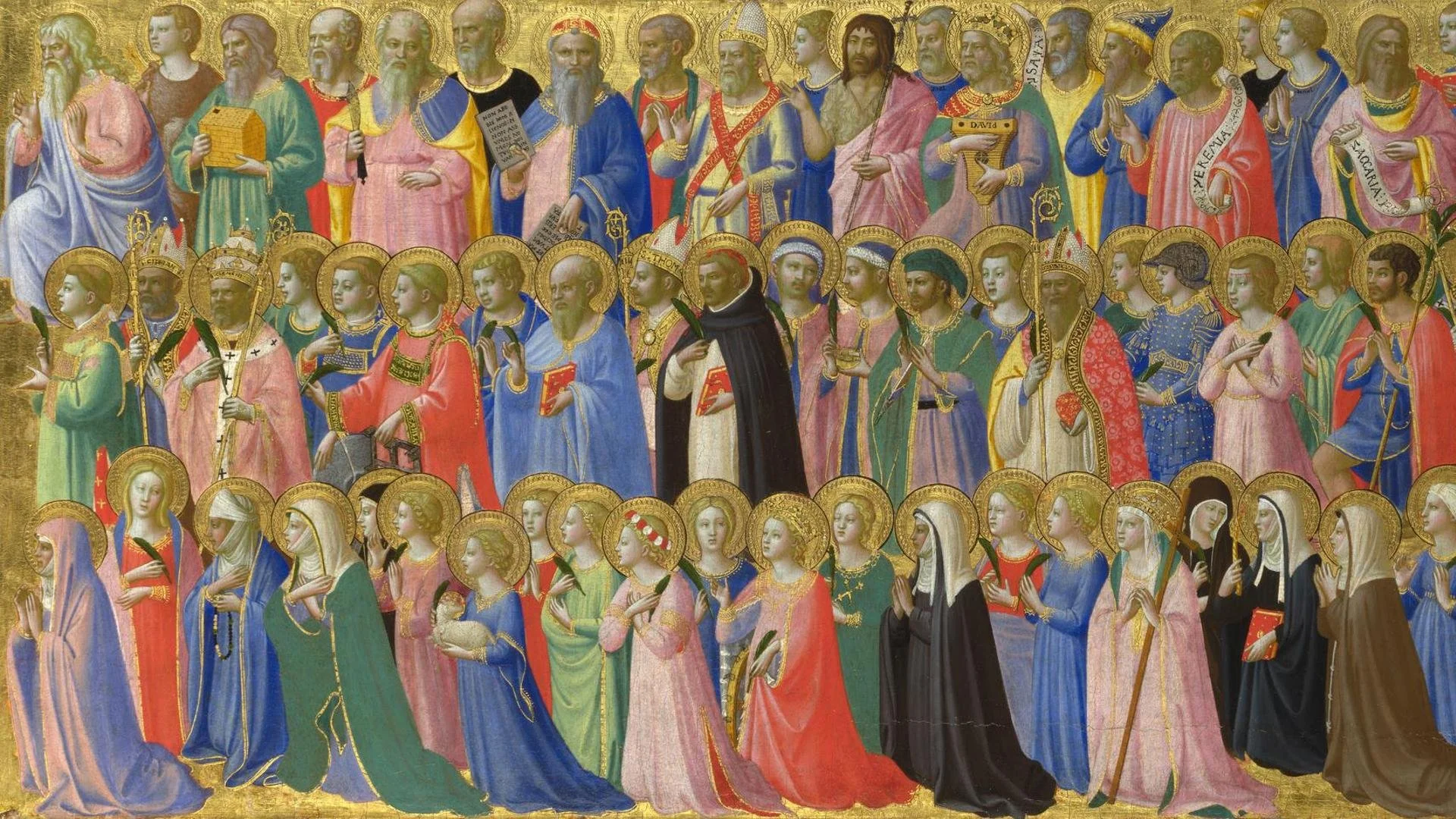
Fra Angelico’s Forerunners Of Christ, sometimes known simply as All (The) Saints.
Here we are again, late in the year, marking (or, at least, passing) All Saints and All Souls Days (November 1st and 2nd…combined with All Hallow’s Eve on October 31st the tiny season is known as Triduum of Allhallowtide). But honouring the Christian dead is older than either feast, even if the dates were only settled later. By the mid-second century, communities marked the anniversaries of martyrs’ deaths as their “birthdays” into heaven. That was fine in the early days when there weren’t that many Christian, let alone martyrs. But Roman Emperor Diocletian’s persecution (303-311) began to produce martyrs faster than any calendar could hold. Churches began pooling them into a single commemoration. In the East, a shared feast of all martyrs existed by the fourth century, and John Chrysostom preached on it in Antioch around 400.
Eastern churches still keep All Saints on the Sunday after Pentecost. In Rome, though, the pivotal moment came in the early seventh century. Emperor Phocas gave the old Roman Pantheon (originally a temple to all the gods), to Pope Boniface IV, who consecrated it as Santa Maria ad Martyres on May 13, 609 (some sources say 610). For about a century afterward, Rome’s feast of the martyrs fell in May.
Why November 1?
The most common explanation for the modern date is that Pope Gregory III (731-741) dedicated a chapel in St. Peter’s to all the saints, apostles, martyrs and confessors, on November 1, which date then became the feast. That is true as far as it goes. But the date was not a Roman invention, and Gregory IV did not originate it. November 1 was already observed in the Irish and Anglo-Saxon churches long before Gregory IV. The Irish martyrologies of Tallaght and Óengus, from around 800, already list an All Saints feast on that date: it was the first day of the Gaelic winter, a liminal time when the world and the otherworld were said to be closer than usual. The Frankish world absorbed the feast partly through these Insular connections. In 835, Pope Gregory IV asked Emperor Louis the Pious to extend the November 1 observance across his realm as well, and that made it effectively universal in the West.
But there was at least one another reason why November 1 suited the Church. The original spring date drew so many pilgrims to Rome that they strained food supplies; but November came right after the harvest, when food was far more plentiful.
How Strong Is the Pagan Connection?
It’s there, but it’s not as strong as with other Christian traditions (like, most famously, Christmas). Samhain, the Gaelic festival on or around November 1, did mark the end of the harvest and the beginning of the dark half of the year. Medieval Irish literature links it with the otherworld, and later folklore records bonfires, feasting and disguise. Because Irish monks heavily shaped the Frankish and English churches, a Samhain influence on the date is certainly plausible (given papal preference for celebrating the same feasts on the same days across Christendom: rather than fight against the old Northern Europe dating, it would have made sense to go with it).
Still, the case is weaker here than for other feasts. All Saints, for example, grew from a tradition that began centuries earlier, in the Mediterranean world, with no Celtic involvement; and there are no known contemporary sources explicitly stating that the Church chose the date to replace Samhain. Most likely, the dates and customs absorbed pre-Christian seasonal habits, while the theology of both days is thoroughly Christian.
All Souls Day
Of the two days, All Saints came first. All Souls came much later, in 998, when Abbot Odilo of Cluny chose November 2 for his new commemoration of the faithful departed. The placement was his decision, and the logic is fairly clear from the theology. All Saints celebrates those already in heaven (the “Church Triumphant”), while All Souls prays for those still being purified (the “Church Suffering”). Putting one directly after the other lets the Church move from honouring the saints to praying for the rest of the dead, so that the whole body of Christians, living and dead, is remembered across consecutive days. Cluny’s network of monasteries spread the observance across Europe.
The Roman Church adopted the observance into its own liturgy by the early fourteenth century. Some popular accounts tie this to the Black Death, though the plague arrived in Europe in the late 1340s, so it may have increased awareness of the date rather than deciding it.
The Reformation divided the traditions. Reformers rejected purgatory and prayers for the dead, so Protestant churches mostly dropped All Souls, though many kept All Saints. The date is also linked to the Reformation itself: tradition says Martin Luther posted his Ninety-Five Theses on October 31, 1517, the eve of All Saints, when crowds were gathering at Wittenberg’s castle church.
Customs and Legends
Folk practice around these days varies widely:
Soul-caking: In medieval and early modern Britain and Ireland, the poor went door to door on November 2 offering prayers for a household’s dead in return for small “soul cakes.” This is almost certainly one (not the only) ancestor of trick-or-treating.
Halloween: The name comes from “All Hallows’ Eve,” the evening before All Saints. Carved turnips, the forerunners of jack-o’-lanterns and pumpkin heads, were used in Ireland and Britain, and games, bonfires and special foods like barmbrack marked the night.
Cemetery traditions: In some countries, families clean graves and light candles. Chrysanthemums are common in much of Europe. Mexico’s Día de Muertos blends Catholic observance with Indigenous Mesoamerican traditions, and marigolds play a central role.
The Halloween Link
Halloween, the most famous of the three-day period, is linked to the other days through its name and its date, and more loosely through shared customs. But it was not a feast day on its own. “Halloween” is a contraction of “All Hallows’ Eve,” the evening before All Hallows’ Day, an old name for All Saints’ Day. Like other major feasts, All Saints began its celebration at sunset the evening before, following the Jewish and early Christian habit of reckoning the day from evening. So October 31 was originally a vigil, a time of prayer and fasting before the feast, not a separate festival. The Gaelic Samhain was a separate pre-Christian festival: one of the major seasonal divisions of the Gaelic year, falling around November 1 and marking the end of the pastoral and harvest season and the start of winter. It just coincided with All Hallows’ Eve.
